National Ancestor Shrine Opens in Paganistan

Sacred Paths Center opens national public ancestor shrine and sacred spirit altar.  Names of Honored Dead from around the globe can be inscribed on plaques and pilgrimages to make offerings welcomed.
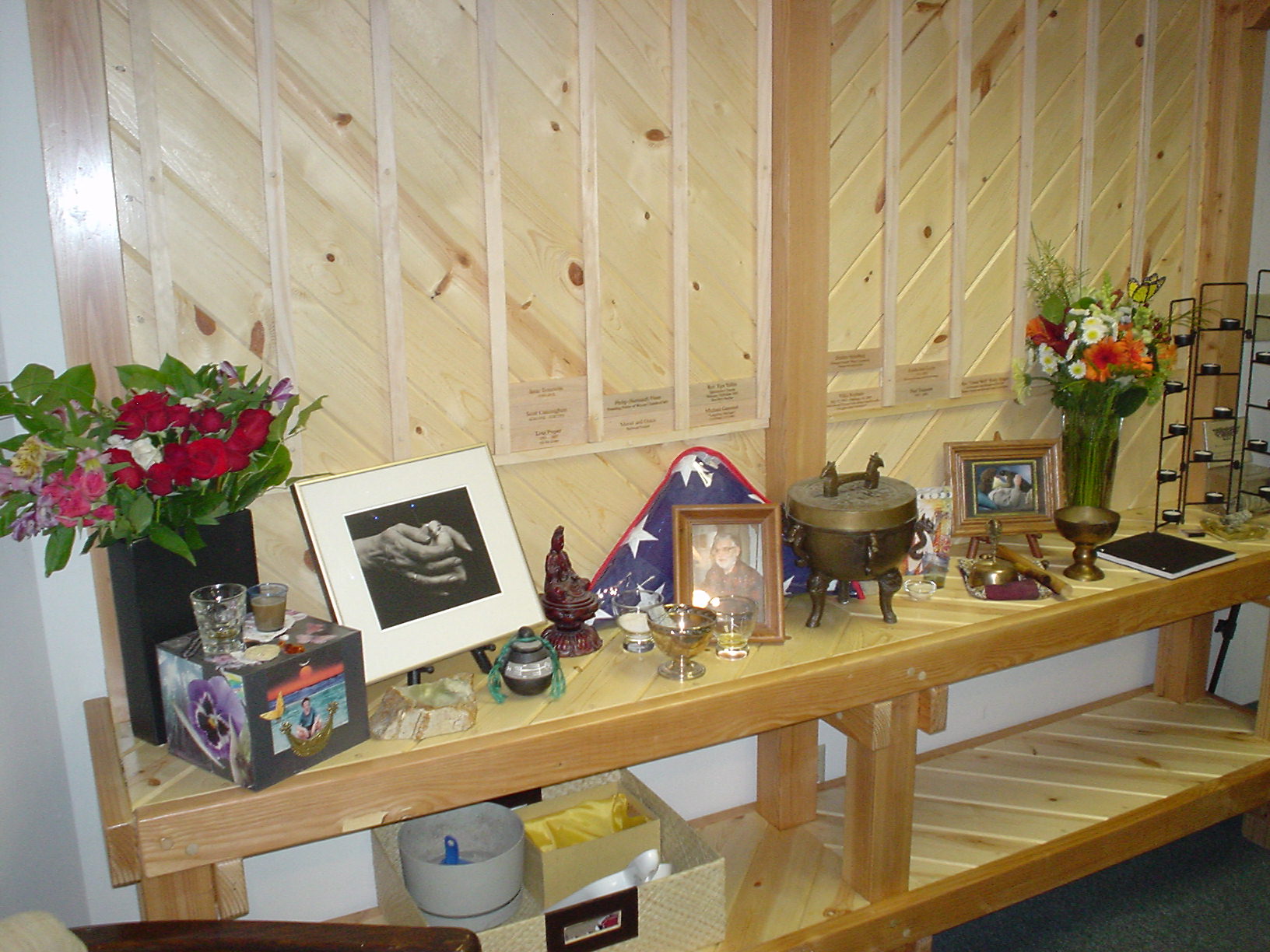
Ancestor shrine and Spirit altar at Sacred Paths Center in St. Paul, Minnesota

“We hope people will treat the shrine like the Vietnam Memorial in Washington, D.C.,” said Mr. CJ Stone, a board member at Sacred Paths, “a pilgrimage to hand down as a tradition, a place where they can go and see the names of their significant dead and honor them. And not just humans. We hope people will remember their animal friends and family, too.”

“People talked a lot about having a shrine like this,” said Teisha Magee, executive director of the Sacred Paths Center. “An altar where anyone could come and light a candle, burn incense, put up a name plaque, or otherwise honor those who have passed the veil. Three of our members—Volkhvy, Ciaran Benson, and CJ Stone—came together with one mind and created exactly that.”

The shrine was designed and built by Volkhvy, who has been working in wood for over 30 years. He put over 120 hours into constructing the shrine. “I built this entirely of wood—without metal of any kind— to reflect the Shinto aesthetic that informs it. It has an ample altar area to use for offerings and to leave
memorabilia. It also has a large vertical area for name plaques.”

“I was very impressed with Volkhvy’s design,” said Ciaran Benson, a Shinto priest who spent two weeks finishing the shrine. “I was right up against this thing, sanding it, so I know intimately every aspect of it. It is beautiful, graceful, large without imposing. I’m proud to have the names of my family, friends, and pets displayed here.”

“Well, I hardly did anything,” said Mr. Stone. “Volkhvy and Ci put their sweat into this and their blood—literally. I just listened to our members and brought the idea and the money to Volkhvy and Ci. But I really can’t say how glad I am to have this. My wife was a prominent figure in Paganistan. When she died, there was no place to memorialize her. Now there is. Hers was the first plaque to go on the shrine when it was finished.”

“The shrine is open to everyone,” said Ms. Magee. “We aren’t checking your Pagan credentials at the door. Candles and incense are available on the altar. Some folks like to leave flowers, food, or other offerings. For a small donation, Sacred Paths Center will inscribe an oaken plaque to go on the shrine. It’s like a small headstone, you get to choose the text and you can include a special message. There’s a plaque request form on the Sacred Paths Center’s website.”

Sacred Paths Center (SPC) is a member-supported, non-profit community center serving alternate religions in Paganistan (the greater Minneapolis-St. Paul metro region) and is the only Pagan community center currently in operation in the USA.  SPC emphasizes Earth-reverent spirituality, but their goal is to provide quality metaphysical merchandise, intuitive services, education, and practice space for seekers of all paths.

Editor’s Note:  To read an excellent editorial on the value of honoring your ancestors, please read Galina Krasskova’s article, Indigenous Heathenry.

(excerpt)

Let me be very clear. The first thing monotheism (and colonialism) did was disconnect us from our ancestors, from our roots, from that precious, precious knowledge of who we are and where we come from. It gave us instead a filter of disconnection, repression, over-intellectualization, excessive stoicism, fear, greed, and confusion. It did this so well that, as I noted above, many of us don’t even realize that we come from indigenous roots; we don’t recognize the filter. Today many Heathens and Pagans talk about reconstruction and restoration, but what does that truly mean? I think reconnection is a far, far better word, and that reconnection begins with the dead. It begins with our willingness to work at that connection. Most of all, it begins with a return to our own indigenous worldview.

So how exactly do we reconnect? As one wiser than I said, one ancestor ritual at a time, one offering to the Gods, one prayer, one thread at a time. Each time you honor your dead, you’re doing something revolutionary. You’re subverting the status quo, a status quo based in colonialism, oppression of our folk ways, and greed. Fight that system. Be subversive.

Celia in Concert Saturday

What could Twin Cities Pagans do to pass the time while their Christian friends get raptured on Saturday? They could go looting, offer to care for pets left behind, or they could listen to Celia at the Sacred Paths Center.

Celia: In Concert
Sacred Paths Center
Saturday, May 21
7:00pm – 9:00pm
Tickets – $12

Celia Farran is perhaps best known and beloved in the Pagan community for her song The Symbol, which helped galvanize the grass roots movement that forced the Veterans Administration to act justly and allow for the Pentagram to be engraved on the burial markers of veterans.

Celia Farran, photo from the video shoot for "Walking the Labyrinth"

Celia has been touring the upper Midwest while filming a video for her song The Labyrinth and stopping in the studios of Simply Folk on Wisconsin Public Radio.  To judge by facebook comments, she has been blowing away audiences with her mix of powerful lyrics and smooth vocals – especially on her remix of Everyday Goddess.  Celia also throws in a bit of improv comedy, which shouldn’t work during the same performance as the serious and many times sacred nature of her lyrics, but somehow does.  Perhaps it is for this, her ability to manifest “mirth and reverence” on stage, that cause some of her fans to call her a Goddess.

PCOD Celebrations Draw Crowds

Just over 20 Pagans attended the local Pagan Coming Out Day celebration at Sacred Paths Center on Monday, May 2nd. The celebration started with a libation and prayer to Hestia, strengthener of family and community bonds, for those Pagans in our community planning to ‘come out’ to someone they know. Champagne cocktails and desserts then followed with a screening of the documentary American Mystic“Speaking as someone who was there, and has been semi-closeted for 35 years, this was simply fabulous,” said Karen.  The movie, which was signed by director Alex Mar, was donated to the Sacred Paths Center library.

International Pagan Coming Out Day Chair, Cara Schulz, spoke to the group about Pagan Coming Out Day and how it was impacting Pagans around the world.  “We have received messages from Pagans in the US, Canada, Russia, France, Columbia, South Africa, and the Philippines to name a few countries.  Very positive stories about the events they are holding, about coming out to friends and family, and about how the religious community has supported them,” said Ms. Schulz.

Ms. Schulz estimates that hundreds of Pagans told someone they know they are Pagan on May 2nd and many more indicated they are considering it after hearing about the mostly positive outcomes on the organization’s facebook page. Others simply decided they would stop hiding their religion and would speak the truth when asked.  Thousands of more ‘out’ Pagans wore something that identified them as Pagan as they went about their normal business as a low key way to push back against stereotypes and show our numbers.  As a sign of how popular the day was, just under 300 t-shirts with the IPCOD logo were purchased in the last 3 months.  “I think it was being able to marshal the support of the community that gave the strength, comfort, and encouragement needed for people to take this step.  Plus the excellent Guide to Coming Out put together by IPCOD committee member Drake Spaeth, PsyD, gave people tips on how to actually have this conversation, said Ms Schulz.  “It’s one thing to say “come on out!” – but it’s another to say this is how you can do it and we’re right here with you to support you.”

Continue reading

Local Celebration of International Pagan Coming Out Day

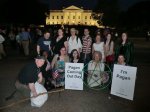
From a formal High Tea to a rally on the White House lawn, Pagans across the globe are celebrating Pagan Coming Out Day on May 2nd with local events and rituals.  The Twin Cities celebration includes cocktails, desserts, and the screening of American Mystic – a movie that the Wild Hunt called “the best documentary involving modern Pagans that this generation has seen.”

The event takes place May 2nd at the Sacred Paths Center and is open to all Pagans and Pagan allies, no matter if you have been ‘out’ for ages or are not yet able to be open about your Pagan spirituality.  It directly follows the usual Monday night Pagan Potluck and the event is offered as a free gift to the community.  An opening Hellenic-style libation to Hestia, a Goddess that strengthens the bonds of family and community,  kicks off the evening, with champagne cocktails, non-alcoholic drinks and desserts to follow.  Once everyone has their treats, the movie American Mystic will be screened for the first time in the Twin Cities area.  The documentary opened at Pantheacon to rave reviews. More about the movie below.

Pagan Coming Out Day Twin Cities
May 2nd – Sacred Paths Center
7pm to 9pm

Pagan Coming Out Day is an international movement created to be complimentary to Pagan Pride events. It’s a day when individuals, deciding on their own terms, stop actively hiding their religious identity to someone in their life. It’s also a day when our religious community comes together to support those coming out to a person or group and celebrates the more public emergence of their Pagan identity.   The not-for-profit organization behind Pagan Coming Out Day says they are “working to achieve greater acceptance and equity for Pagans at home, at work, and in every community.” To learn more about Pagan Coming Out Day you can go to their website or friend them on facebook.

Chuck, a Lakota sundancer in the badlands of South Dakota

Morpheus, a Pagan priestess in southern California

Kublai, a Spiritualist in upstate New York

AMERICAN MYSTIC is a documentary about three twenty-somethings, each a member of a fringe religious community, who have separated themselves from mainstream America in order to live immersed in their faiths. Kublai, a Spiritualist in the former revivalist district of upstate New York; Chuck, a Lakota sundancer in the badlands of South Dakota; and Morpheus, a Pagan priestess living off the grid in old mining country in southern California. Rather than an analytical, journalistic approach, AMERICAN MYSTIC takes a personal, visually lush approach, immersing the viewer in the subjects’ experience of their controversial faiths through their own words and worship.

Editor’s note:  Cara Schulz, editor at PNC-Minnesota, Chairs the Executive Committee of International Pagan Coming Out Day.  Jason Pitzl-Waters, Project Coordinator of PNC and author of the The Wild Hunt, also serves on the Executive Committee.

Sacred Spaces Part 5 – Funding and Sustaining a Community Center

Sacred Spaces is a series that looks at successful examples of modern Pagans creating and maintaining permanent places for worship and fellowship. In this segment, we look at how Sacred Paths Center, a Pagan community center in St Paul, made it through a financial crisis that could have closed its doors and emerged financially sustainable.

In Part 6 of Sacred Spaces, we talk with Sacred Paths Center Executive Director Teisha and Board member CJ Stone about the profound impact the community center has had on the Pagan community in the Twin Cities and why it is worth the effort, sweat, and money to have a place where Pagans can be Pagans.

Previous segments of this series can be seen here:
Part 1 – Temple of the River: Getting started
Part 2 – Temple of the River: Challenges and Construction
Part 3 – Temple of the River: Funding
Part 4 – Sacred Paths Center: Birth of a Community Center