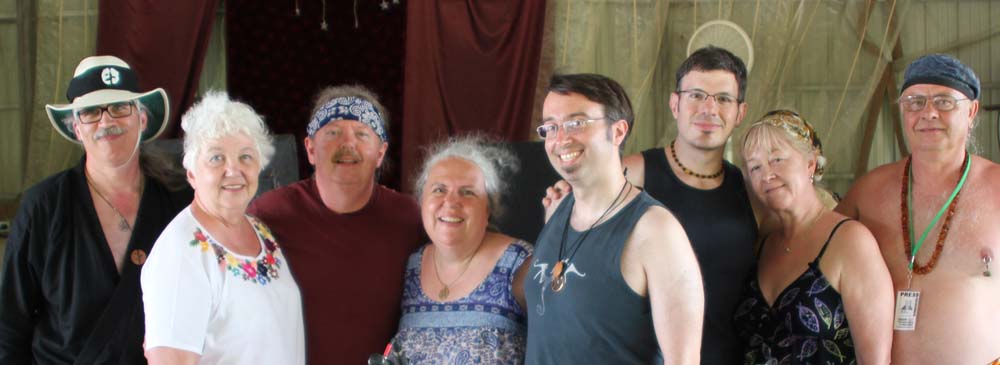
Standing Stones Mabon – Interview

I had the honor to attend the Coven of the Standing Stones community Mabon celebration last weekend. This is a private, by invitation event, but those for whom it is needed, or appropriate for, always seem to find an invitation (or you can ask for one). If you ask; “What is this coven known for?” , most would say they excel in the ‘craft’ of the Craft, they put together a solid ritual experience. They are the most welcoming group you will find, and take pride in their diversity and inclusiveness.  Standing Stones has been supportive of many community groups and events over the years, particularly helping the local Covenant of the Goddess raise needed funds for survival a few years back, and ongoing help cleaning the highway with the Upper Midwest Pagan Alliance (UMPA) and raising funds for that group. If you can’t find them at Magus Books offering free classes, look wherever you see Pagan community growing and they are likely somewhere involved!

Standing Stones is a coven of leaders.  I got a chance to corner three of the most visible. Don, John, and Tamara, and ask some questions.

How long have you been doing a community Mabon?
John: This is the eighth year we have held this event as a community Mabon.

How many folks do you have attending?
John:  By our count, close to 120. A pretty good turnout! It’s a large family.

This slideshow requires JavaScript.

Why do you hold this event?
John:  It is a way we give back to our community. By giving back some of our bounty, we help build our community. Our community gives to us and we have to give something back.

We started inviting our community to celebrate Mabon with us about eight years ago. About 70 people attended. Some in our community have been at every one. We feel honored by that. We used to hold both a community Ostara and a Mabon, because we liked honoring the balance of light and dark at both times of the year. But they got so large and came up so quickly that we decided it was best to just offer one. We picked Mabon because it is a time of abundance. We thought, let’s feed everybody and pick a time when we can all be outside and enjoy some great weather.

Continue reading

Andras Corban Arthen – Sacred Harvest Festival Guest – Interview

I can listen to Andras Corban Arthen all day. He has a rich, low voice with the gentle cadence of caring. He has a lifetime of experience in the Pagan community, and the depth of perception and the wisdom of his words keeps you riveted.  He is presenting and performing all next week at Sacred Harvest Festival, near Geneva, Minnesota.  Advance registration closes today, gate registration is available during the event Aug. 6-12th.

Andras Corban Arthen

You are just back from Europe, what were you doing there?

Andras: I go to Europe fairly often, since I have family and friends across the pond (I’m from Spain, originally), and a big part of my work is focused there. This trip served several purposes, the main one being related to a book I am writing, based on one of the presentations I will be doing at Sacred Harvest Festival (SHF) entitled The “Indians” of Old Europe. It looks at the cultures and spiritual practices that were originally called “Pagan” in the context of indigenous traditions from around the world. For over 35 years I’ve been searching for people in Europe who may be keeping alive the remnants of the old ethnic spiritual traditions of their countries, and have found some, both in Eastern and Western Europe, mostly in small, rural, out-of-the-way places where the old languages are still spoken. Most of them do not use the label “Pagan,” though their practices are not Christian and appear to be authentically very old. In some significant ways, they are quite different from what one typically finds in the modern pagan movement, and there are some important things that I think we could learn from them. When I first met these people I hadn’t been planning to publish a book, so before going further with this I needed to go back to touch base with them in person and ask for permission to write about them, their beliefs, and practices. I was able to do that with four of them, and in two of those cases wound up getting more information than I had before, so I’m pretty satisfied on that account.

Continue reading

Crystal Blanton Returns For Sacred Harvest Festival “RJ” Circle – Interview

Crystal Blanton

Crystal Blanton is returning to Sacred Harvest Festival,  Aug 6-12th.  She is bringing her whole family to experience the festival, and is offering a second  Restorative Justice Circle as a service.  Harmony Tribe is facilitating community participation by non-registrants of the festival  for this event, Thursday, Aug. 9th, 10am at the festival site in Geneva, Mn. I talked to her by phone:

You are back at Sacred Harvest Festival (SHF) ?

Crystal: Yes, I had such a good time last year and I made such incredible connections with people that I really, really wanted to go back, and I wanted to share that experience with my family. I knew that if I could make it happen, I would.

Are you familiar with SHF Guest, Yeshe Rabbit?

We are both in the Bay area, and have had a great connection with each other as we both have continued to grow along our paths. I am really excited that she is one of the national guests this year. I think she will give the festival a great service. I visit her store often. I don’t work within her coven, but because we both are in the Bay area and do leadership type programs we come across each other frequently. We have been able to develop a great working relationship and friendship together even though we don’t work in the same coven.

Crystal at SHF 2011
with Bear Eared Hat

You are offering another Restorative Justice Circle  (RJ) at SHF, why a second one?

Usually when we do an RJ circle around a particular topic there is a follow-up. We do that as a means to make sure that after the first interaction that people have had the opportunity to be a part of the solution and deal with whatever has come up since the initial engagement. In this kind of scenario, my thought was to come back and offer that same kind of opportunity for people to engage in a follow-up but to also focus on some community building type exercises supporting the community with moving forward and gaining more tools as a community in that rebuilding process. This is the benefit for participating if you participated last year, to support going from one phase to the next phase of healing and restoring community values.

What if this is your first RJ experience, what would be the benefit?

As I am designing this my initial plan will likely change once I connect with the community. There is always what we think we want to do, and then once there, what is needed. My guess is that it would have a portion set aside to talk about the past year, and the feelings and emotions associated with the rebuilding of community. I want to focus more on that direction, but that is just based on impressions of what I left a year ago. Since this will be open to community, it also depends on who decides to participate and attends. Part of the RJ process, that can be both challenging and important, is to be able to move within the needs of the community which we are serving at that moment. Because I don’t know what portion of the HT community will be participating, I have to leave that somewhat open at this time. There will be time to get some basic feelings out, but my main push will be to get to the next phase of restoring.

Continue reading

Yeshe Rabbit – Sacred Harvest Festival Guest – Interview

Lady Yeshe Rabbit
Sacred Harvest Festival Guest

I talked to Lady Yeshe Rabbit of the Come As You Are (CAYA) coven. We talked about her work in the San Francisco Bay area, her appearance at Sacred Harvest Festival, and her thoughts on gender issues in the Pagan community.

How do you like to be addressed?
For the most part you can call me Rabbit. My title in my coven is Yeshe, it is a word that has a few different meanings. In Tibetan it means “primordial wisdom”, and that is why I took the title, because I wanted to be guided by that primordial wisdom that resides within. It was also a childhood nickname, because I am Polish and my birth name is Jessica.

Tell me about CAYA?
CAYA coven is my coven.   There is within CAYA several different layers of membership. Some people have a casual relationship and may just attend our rituals. There is also an inner circle of trained clergy. These are people who have been with the group for a number of years. They would be my ‘closer’ coven you might say.

What is the role of CAYA in the Bay area?
CAYA stands for “Come As You Are”, and it is a coven that is built around the principles of eclecticism, inter-faith, and support for a wide variety of different paths. An individual who maybe has a very strong personal path, or, one who might be  just starting out and wants to learn about many different paths to see which one is the right fit, would find themselves very comfortable in CAYA. Each of us in CAYA feels that it is the utmost importance the we determine our own personal relationship with the divine. We then share our own individual practices and spiritual beliefs in the spirit of generosity without presuming that we know the one way that is right for everyone. What that means is that we are a coven “filled with solitaries” (jokingly), because everyone has their own individual practice. When we come together we join around a central core of protocols of how we do rituals in an outlined format, a baseline of ethics that we have all agreed to, and principles of community that we think are essential:  Cooperation, conflict resolution, clergy conduct and comportment. When people come into CAYA they feel very welcome, even if a beginner, or if they are extremely experienced and just don’t want to be told what to do because they are confident in their own path.

Continue reading

Dawning of a New Day – Editorial

My wife,  Judy Olson Linde,  and I  appeared as guests this year at the Heartland Pagan Festival near Kansas City, Mo. I wrote this article for their newsletter, which was also published in their festival guide. It is excerpted below;  The theme of the festival was  “Dawning of a New Day” and I was thinking about what it would take for us, as a Pagan Spiritual community, to achieve that dawn.

Guests at Heartland Pagan Festival 2012 – Judy and Nels Linde at far right
photo: Aaron Smith

The Heartland Theme this year  really attracted us to contribute differently this year, as guests. In recent years most Pagan communities, organizations, festivals, and even small groups have experienced some kind of internal turmoil, and so have we. Our easiest reaction to this is to withdraw to personal isolation. We attribute conflict to, “Just politics, Pagans can’t agree on anything”. We may have just stuck our head up and tried to get involved in a community just in time to get it bit off, so back we go into the safety of isolation. If you persist and stay involved in community work you often see the same destructive processes repeated over and over. Working together to build a community of support, something beyond ourselves, can seem a hopeless task.

Respectful disagreement is a sign of change, and can be a motivator toward moving in new directions. When change can be so beneficial, why does it so often end up being harmful to individuals and communities, instead of an opportunity for growth? Is it an essential truth that Pagans working together is like ‘herding cats’? It doesn’t have to be. Working together doesn’t have anything to do with ‘herding’, and, have you ever seen film of a pride of lions hunt? Differences don’t need to be a source of disruption. Diversity of views in decision-making can be a group’s greatest asset.

Continue reading