Sacred Path Center – Update – Interview with CJ Stone, Board spokesman

The Sacred Paths Center (SPC)  Board met for their regularly scheduled meeting last night, however all scheduled business was tabled to focus on the financial affairs of the Center. A board quorum was present, and several Board members contributed to the discussion by phone.  The SPC website now has installed a fund-raising thermometer to depict their progress toward the immediate $7500 goal, of which half will be matched by other donations. They are currently at 20% of this goal.

*NOTE.  The Sacred Paths Center is continually updating their website with fund raising progress and new events.  Please check their website for updates on their current situation !


CJ Stone, Board member, has been delegated spokesman for the Sacred Paths Center. I was able to interview him last night,  Friday July 8th, after the Board meeting.

What is the financial status of the SPC?

CJ Stone, Board Member, spokesman:

The immediate needs to keep the doors temporarily open were covered. The Center needs 7500 dollars to continue to operate through this month. The Board has decided that 12,000 was what we needed by midnight of July 30th or we will close the facility. If we can secure that 12k dollars, we can pay our bills to zero and have a positive balance to keep the center open and by able to steer the Center in a direction that will be financially viable.

What changes would make it viable? Continue reading

Sacred Paths Center in Crisis – Broke, Closure Imminent

From The SPC website: http://sacredpathscenter.com/  :

Sacred Paths Center, the Spiritual/Pagan Center, open to all, first of its kind in the United States, is broke.

“What, AGAIN?”

Yes.

“Now why?”

Simple: lack of YOUR support. This message will reach thousands and thousands, but how many of you will care enough to do anything?

A physical banner has been put in the ground here, proclaiming this area as sacred to us; SPC is that banner. “Pagan Community”, “Paganistan”…it seems they are just words. There are thousands of us here in the Twin Cities metro, and among us all, we can’t give $3000 a month to keep that banner standing open. What does that say—really say—about “Pagan Community”? Less than a dollar each, and yet… Continue reading

Book Review: Tears of the Sun

This installment in the Emberverse series adds depth to the narrative, further develops familiar friends, introduces new characters, and contains a hero’s death. Mild spoilers.

Book:  Tears of the Sun
Author:  SM Stirling
Publish Date:  September 2011
Sample Chapters
Buy the book:  Amazon and Barnes & Noble
Author’s Yahoo Group
Previous PNC coverage of SM Stirling: Author’s Books Change Opinions About Paganism
WitchVox article:  Creating a Wican Tribe

Background on the series:  A mysterious event happens across the globe that results in 90% of the population dying within one year through starvation and disease. Electricity, gun powder, cars, all the things that make modern life possible stop working. These books could have come across as grim, but the author focuses on how humans band together and not only survive, but thrive in this new world they find themselves in. The books contain classic fantasy elements, but the setting and the characters are not. They are your friends and neighbors and is set in towns you live and work in.

Those that survive The Change (as the event becomes known) band together in small, isolated groups and form new, surprising cultures. After living through the horrors of those early days, people push their immediate past into the land of myths and mine myths for ways to reinvent their lives. A professor of medieval history and his SCA friends use feudal England as a model for a new society. It turns out being handy with a sword is valuable in a world where guns no longer work. A soldier turned devout monk is elevated to Abbot and the abbey becomes a fortress to guard the flock from roving bands of cannibals. Teenagers infatuated with Tolkin grow into serious scouts and caravan guards as the Dundain Rangers. Iowa, due to its ability to feed its population, becomes the most powerful area left in the old United States. Bib overalls and a feed cap become the dress of the upper class and Farmer is a title of respect. An Army officer in Boise dreams of holding the United States together and preserving the Constitution, but instead recreates the Roman Legions. A pseudo-Celtic clan is formed in Oregon when a community coalesces around a Wiccan coven with a Bard and powerful witch as a High Priestess. The Lakota once again follow the ways and Gods of their ancestors and the buffalo number in the millions.

 Tears of the Sun takes place 25 years (and 7 books) after The Change. The main hero, Rudi Mackenzie, has fulfilled his quest to find the fabled Sword of the Lady, but now he has a war to fight and win. The maxim “As above, so below” is lived out as the Gods – all of them – walk the earth and weigh in on the war. After all, the fight is really Theirs being played out among men. The book follows the leaders of the Dundain Rangers as they plan a daring rescue in the very heart of enemy territory and goes back in time a bit to cover the events happening back in the newly formed High Kingdom of Montival (formerly the NE Untied States and parts of the Midwest). Much needed information is filled in and the plot action helps advance the series, but it isn’t the action scenes that steal the show in Tears of the Sun – it’s the death of a main character and the development of another.

Continue reading

National Ancestor Shrine Opens in Paganistan

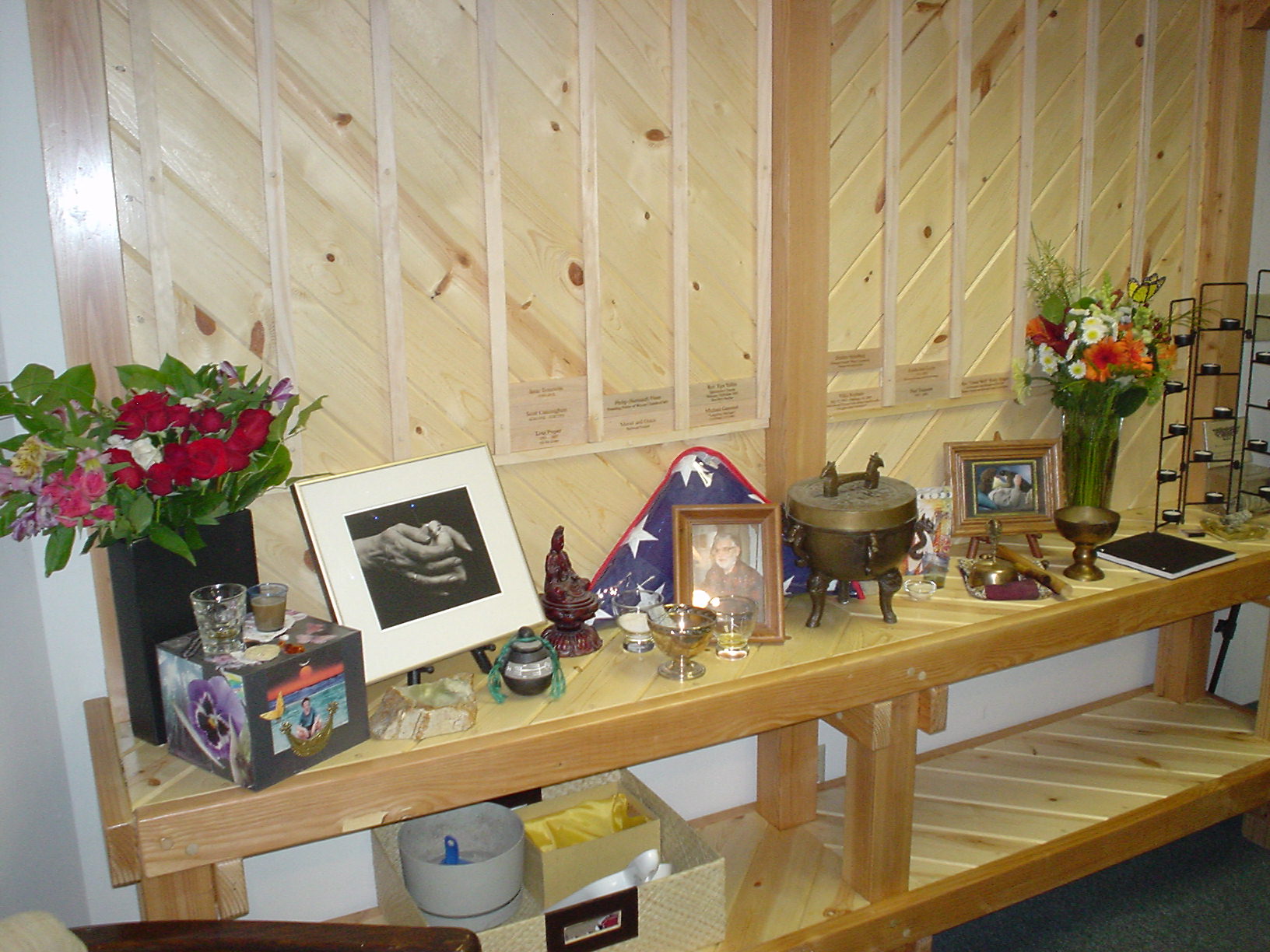
Sacred Paths Center opens national public ancestor shrine and sacred spirit altar.  Names of Honored Dead from around the globe can be inscribed on plaques and pilgrimages to make offerings welcomed.

Ancestor shrine and Spirit altar at Sacred Paths Center in St. Paul, Minnesota

“We hope people will treat the shrine like the Vietnam Memorial in Washington, D.C.,” said Mr. CJ Stone, a board member at Sacred Paths, “a pilgrimage to hand down as a tradition, a place where they can go and see the names of their significant dead and honor them. And not just humans. We hope people will remember their animal friends and family, too.”

“People talked a lot about having a shrine like this,” said Teisha Magee, executive director of the Sacred Paths Center. “An altar where anyone could come and light a candle, burn incense, put up a name plaque, or otherwise honor those who have passed the veil. Three of our members—Volkhvy, Ciaran Benson, and CJ Stone—came together with one mind and created exactly that.”

The shrine was designed and built by Volkhvy, who has been working in wood for over 30 years. He put over 120 hours into constructing the shrine. “I built this entirely of wood—without metal of any kind— to reflect the Shinto aesthetic that informs it. It has an ample altar area to use for offerings and to leave
memorabilia. It also has a large vertical area for name plaques.”

“I was very impressed with Volkhvy’s design,” said Ciaran Benson, a Shinto priest who spent two weeks finishing the shrine. “I was right up against this thing, sanding it, so I know intimately every aspect of it. It is beautiful, graceful, large without imposing. I’m proud to have the names of my family, friends, and pets displayed here.”

“Well, I hardly did anything,” said Mr. Stone. “Volkhvy and Ci put their sweat into this and their blood—literally. I just listened to our members and brought the idea and the money to Volkhvy and Ci. But I really can’t say how glad I am to have this. My wife was a prominent figure in Paganistan. When she died, there was no place to memorialize her. Now there is. Hers was the first plaque to go on the shrine when it was finished.”

“The shrine is open to everyone,” said Ms. Magee. “We aren’t checking your Pagan credentials at the door. Candles and incense are available on the altar. Some folks like to leave flowers, food, or other offerings. For a small donation, Sacred Paths Center will inscribe an oaken plaque to go on the shrine. It’s like a small headstone, you get to choose the text and you can include a special message. There’s a plaque request form on the Sacred Paths Center’s website.”

Sacred Paths Center (SPC) is a member-supported, non-profit community center serving alternate religions in Paganistan (the greater Minneapolis-St. Paul metro region) and is the only Pagan community center currently in operation in the USA.  SPC emphasizes Earth-reverent spirituality, but their goal is to provide quality metaphysical merchandise, intuitive services, education, and practice space for seekers of all paths.

Editor’s Note:  To read an excellent editorial on the value of honoring your ancestors, please read Galina Krasskova’s article, Indigenous Heathenry.

(excerpt)

Let me be very clear. The first thing monotheism (and colonialism) did was disconnect us from our ancestors, from our roots, from that precious, precious knowledge of who we are and where we come from. It gave us instead a filter of disconnection, repression, over-intellectualization, excessive stoicism, fear, greed, and confusion. It did this so well that, as I noted above, many of us don’t even realize that we come from indigenous roots; we don’t recognize the filter. Today many Heathens and Pagans talk about reconstruction and restoration, but what does that truly mean? I think reconnection is a far, far better word, and that reconnection begins with the dead. It begins with our willingness to work at that connection. Most of all, it begins with a return to our own indigenous worldview.

So how exactly do we reconnect? As one wiser than I said, one ancestor ritual at a time, one offering to the Gods, one prayer, one thread at a time. Each time you honor your dead, you’re doing something revolutionary. You’re subverting the status quo, a status quo based in colonialism, oppression of our folk ways, and greed. Fight that system. Be subversive.

Patriotism Has a Place

It is not always a popular notion within Paganism to express patriotic sentiments.  Then again, I’ve never been one to worry excessively about being popular.

Fireworks over the Statue of Liberty, photo credit: Zingerbug

I love this country.  I have a full realization of how fortunate I am to have been born here and I try not to take that for granted.  I honor Columbia, Patron Goddess of our land, and I hope She continues to bless us even though we often don’t uphold Her ideals.

When I make a statement like that around fellow Pagans I get three types of responses.   The rarest is agreement.  More common is a list of all the wrongs our country has perpetrated over the span of its existence.  The third type of response is a cautionary tale of tribalism, nationalism, and veiled insinuation that to love your country is to be racist and oppressive.

I am aware of the bad and the good my country does, yet my opinion stands.  Just as my spouse is aware of my virtues and my faults, loves me anyway, and chooses each and every day to stay with me (poor bastard) –  I love my country and prefer it to all others. I love it with my eyes and my heart wide open.

But doesn’t loving your country and admitting to feeling patriotic surges in your heart mean you are in danger of the worst excesses of nationalism?  Oppression and racism?  Just because I love my country doesn’t mean I hate other countries any more than loving my house  means I want to burn yours down.  Don’t believe me?  Invite me over for dinner.  I’ll respect your home and enjoy your company just as I appreciated the various countries I’ve visited and lived in.  I give good guest.

Statue of the Goddess Freedom on top of the US Capitol. The blending of Greek, Roman, and First Nations cultures are displayed in how we depict our Goddess.

Today I wholeheartedly celebrate the start of the current cycle of ‘rebirth’ of our land – the date when the signing of the Declaration of Independence was announced.  When the Founding Fathers of the United States looked for a model to base our government on, they looked as much to the Iroquois Confederacy (the worlds oldest continuous democracy) as they did to Pagan Greece and Rome.    Franklin, Jefferson, John Adams, and Washington were all familiar with the Iroquois polity. European philosophers such as Locke, Roussea, More, and Hobbes were influenced by the societies of the First Nations.  When I celebrate the 4th of July, I honor those cultures and the profound impact they have in shaping the United States and our current form of governance.  I celebrate our place in the cycle of the land, I honor those who came before and who come after me.

Today I pour a libation and shoot off a few fireworks for the Goddess of this land – Columbia Eleutheria (Freedom), also called Libertas (Liberty).  Lady Liberty.   She has walked this land since it formed and is a guardian of freedom and a generous granter of plenty.  It is She who stands in the New York harbor welcoming those seeking a better life.   She will guard this land long after we are dust and our government falls and a new takes its place.  She always works to light the fires of justice, compassion, and liberty in the hearts of whoever resides on her shores.

Some see her as a construct, something made up similar to Uncle Sam or the Easter Bunny.  They are welcome to their opinion, but as a polytheist I see the divine as always revealing itself to us, not something we call into existence out of some pathetic need for things larger than ourselves.  The world is filled with Gods and Goddesses willing to reveal themselves if we open ourselves up.  Land spirits and other gods tied to a place abound.  Old Man Mississippi and the water nymphs at Coldwater Spring are as deserving of honor and reverence as Gods like Okeanos and Brighid.  Columbia is no less deserving of libations in the United States than Athene is in Athens.

Tonight I’ll honor Her with offerings and pray that She blesses us with Her gifts.  Guide us – our country seems to be at a crossroads and is facing difficult times.  Our nation’s identity and ethics are muddled.  Like many times before, we have lost sight of Her, and we need Her beacon to guide us back on the path to respect for the rights of the individual coupled with acknowledgment of the needs of the community.  But above all…freedom.

Freedom to practice our religion unimpeded by the government.

Freedom to say what we think without fear of imprisonment.

Freedom to keep arms.

Freedom against having the government illegally search our property and take our belongings.

Freedom to have a fair and just legal system.

I hope you enjoy a wonderful 4th of July celebration today – whether you join the increasing number of Pagans who celebrate it as a festival day in honor of Columbia Liberty or if it is a purely secular holiday for you.