Sacred Paths Center in Crisis – Broke, Closure Imminent

From The SPC website: http://sacredpathscenter.com/  :

Sacred Paths Center, the Spiritual/Pagan Center, open to all, first of its kind in the United States, is broke.

“What, AGAIN?”

Yes.

“Now why?”

Simple: lack of YOUR support. This message will reach thousands and thousands, but how many of you will care enough to do anything?

A physical banner has been put in the ground here, proclaiming this area as sacred to us; SPC is that banner. “Pagan Community”, “Paganistan”…it seems they are just words. There are thousands of us here in the Twin Cities metro, and among us all, we can’t give $3000 a month to keep that banner standing open. What does that say—really say—about “Pagan Community”? Less than a dollar each, and yet… Continue reading

National Ancestor Shrine Opens in Paganistan

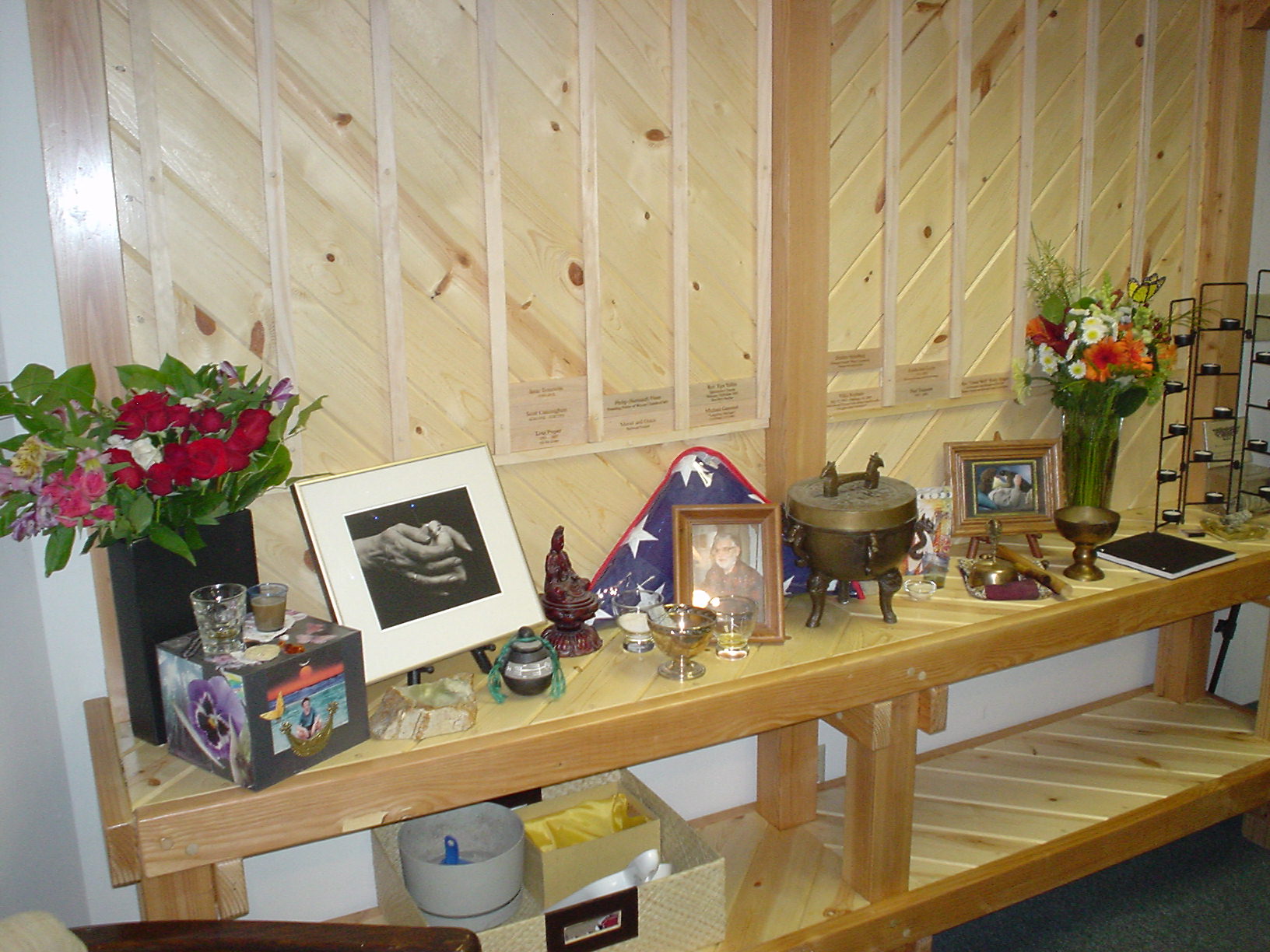
Sacred Paths Center opens national public ancestor shrine and sacred spirit altar.  Names of Honored Dead from around the globe can be inscribed on plaques and pilgrimages to make offerings welcomed.

Ancestor shrine and Spirit altar at Sacred Paths Center in St. Paul, Minnesota

“We hope people will treat the shrine like the Vietnam Memorial in Washington, D.C.,” said Mr. CJ Stone, a board member at Sacred Paths, “a pilgrimage to hand down as a tradition, a place where they can go and see the names of their significant dead and honor them. And not just humans. We hope people will remember their animal friends and family, too.”

“People talked a lot about having a shrine like this,” said Teisha Magee, executive director of the Sacred Paths Center. “An altar where anyone could come and light a candle, burn incense, put up a name plaque, or otherwise honor those who have passed the veil. Three of our members—Volkhvy, Ciaran Benson, and CJ Stone—came together with one mind and created exactly that.”

The shrine was designed and built by Volkhvy, who has been working in wood for over 30 years. He put over 120 hours into constructing the shrine. “I built this entirely of wood—without metal of any kind— to reflect the Shinto aesthetic that informs it. It has an ample altar area to use for offerings and to leave
memorabilia. It also has a large vertical area for name plaques.”

“I was very impressed with Volkhvy’s design,” said Ciaran Benson, a Shinto priest who spent two weeks finishing the shrine. “I was right up against this thing, sanding it, so I know intimately every aspect of it. It is beautiful, graceful, large without imposing. I’m proud to have the names of my family, friends, and pets displayed here.”

“Well, I hardly did anything,” said Mr. Stone. “Volkhvy and Ci put their sweat into this and their blood—literally. I just listened to our members and brought the idea and the money to Volkhvy and Ci. But I really can’t say how glad I am to have this. My wife was a prominent figure in Paganistan. When she died, there was no place to memorialize her. Now there is. Hers was the first plaque to go on the shrine when it was finished.”

“The shrine is open to everyone,” said Ms. Magee. “We aren’t checking your Pagan credentials at the door. Candles and incense are available on the altar. Some folks like to leave flowers, food, or other offerings. For a small donation, Sacred Paths Center will inscribe an oaken plaque to go on the shrine. It’s like a small headstone, you get to choose the text and you can include a special message. There’s a plaque request form on the Sacred Paths Center’s website.”

Sacred Paths Center (SPC) is a member-supported, non-profit community center serving alternate religions in Paganistan (the greater Minneapolis-St. Paul metro region) and is the only Pagan community center currently in operation in the USA.  SPC emphasizes Earth-reverent spirituality, but their goal is to provide quality metaphysical merchandise, intuitive services, education, and practice space for seekers of all paths.

Editor’s Note:  To read an excellent editorial on the value of honoring your ancestors, please read Galina Krasskova’s article, Indigenous Heathenry.

(excerpt)

Let me be very clear. The first thing monotheism (and colonialism) did was disconnect us from our ancestors, from our roots, from that precious, precious knowledge of who we are and where we come from. It gave us instead a filter of disconnection, repression, over-intellectualization, excessive stoicism, fear, greed, and confusion. It did this so well that, as I noted above, many of us don’t even realize that we come from indigenous roots; we don’t recognize the filter. Today many Heathens and Pagans talk about reconstruction and restoration, but what does that truly mean? I think reconnection is a far, far better word, and that reconnection begins with the dead. It begins with our willingness to work at that connection. Most of all, it begins with a return to our own indigenous worldview.

So how exactly do we reconnect? As one wiser than I said, one ancestor ritual at a time, one offering to the Gods, one prayer, one thread at a time. Each time you honor your dead, you’re doing something revolutionary. You’re subverting the status quo, a status quo based in colonialism, oppression of our folk ways, and greed. Fight that system. Be subversive.

Breaking: Patrick McCollum speaks about court case, seeks direction from community

McCollum calls press conference to clear up misconceptions in Pagan prisoner rights case. Alleges state admitted to perjury, destroyed key documents. Systemic discrimination. Says states are moving to end chaplain programs and replace with privately funded Evangelical chaplains. McCollum must decide next step in legal battle withing the day, asks community for input.

Monday night, Pagan minister and civil rights activist Patrick McCollum called a press conference at the 2011 Pagan Spirit Gathering.  McCollum discussed the recent 9th Circuit Court ruling in the Patrick M. McCollum; et al., v. California Department of Corrections and Rehabilitation; et al. case.  McCollum called the presser to clear up what he saw as misunderstandings and misrepresentations of the case in the mainstream media and in the Pagan community.  He also said that the Pagan community needs to know how this case affects Pagans across the country, both inside and outside the prison system.

McCollum stated since this is a federal case, it affects how the government interacts with minority faiths far beyond the borders of California.  Likewise, the nature of the case doesn’t limit it to only the prison system.  It is applicable to all federal agencies.  McCollum said if the Pagan community understood how the ruling could be applied and that it does affect them, they would mobilize similar to the VA Pentacle Quest.

McCollum said this action by the correctional department was part of a larger movement by fundamentalist Christians to  use governmental institutions to pressure persons to convert to aggressively proselytize, such as was seen in the Air Force Academy in the USA.  Aggressive, and sometimes violent, proselytizing is also being carried on by some Evangelical groups in places like Haiti, India, and in Africa.  He outlined how the California correctional system officials heavily discriminated against McCollum and Pagan inmates over a period of years while pressing him to file a lawsuit.  Prison systems in three other states have since cited court costs associated with minority religion discrimination cases, such as the one McCollum filed, as a reason to end the state run chaplain program.  The prison systems then allow private religious 501c3s to bid on administering a private chaplain program and the groups selected pay all costs.  McCollum says that Pagans shouldn’t be surprised that the winners of these bids are mainly Evangelical Christian groups.

McCollum listed how prison officials had admitted to perjury, shredded thousands of inmate grievance filings, and how the court had continued to use the perjured testimony as a basis for its ruling.  He also noted that the headlines stating he lost a ruling based on standing is incorrect.  The case was started as a class action lawsuit involving prison inmates, but that portion of the case was thrown out.

Towards the end of the press conference McCollum said that he had a decision to make regarding the case.  If McCollum decided to continue fighting this in court, it could be 8 or more years before there is a final resolution.  He has already been involved in this case for over seven years.  He said it is very emotionally and financially draining to fight a legal battle of this magnitude, but he has done so because it’s the right thing to do.  He laid out his options as he sees them.  He could push this fight through and seek to eventually end up in the Supreme Court.  He noted that SCOTUS hears very few cases each year and the likelihood of the court taking this case is small.  He could seek a settlement with the state of California.  Or he could drop the case and fight it in the public arena similar to the pentacle Quest.  For any of these options he would need the support of the entire Pagan community.  It is for this reason that McCollum is seeking to hear from the community on what they feel he should do – continue in the courts or drop the case and use social pressure to affect change.  He asks that Pagans comment quickly as he was given a shortened time frame to decide.  He has less than 24 hours from the time of this publication.

A longer report of the presser is to follow along with links to the audio of the full press conference.

Upper Midwest Pagan Alliance Cleans Up! – Editorial

The highway cleanup on Interstate 35E, sponsored by the Upper Midwest Pagan Alliance (UMPA),  took place Saturday June 4th. The cleanup had been delayed by the storms that swept through the Twin Cities the weekend of May 21st. A cheerful group of seven met,  and after going over safety and procedure concerns, hit the road by 11am.  It was a beautiful summer day!

UMPA sign view headed South on 35E

We split into two teams and also had vehicle support with water, bars, and sandwiches nearby. With no adjacent fast food, the pickings were light with the exception of a few with a taste for “Ice House’ beer making frequent deposits!  By about 2pm the ending overpass was in sight, and it had heated up a bit.  On cue a generous breeze made the remaining cleanup feel much easier. This was the first spring cleanup of this site near Hugo, MN., after the move from Coon Rapids. With three on a side, we had just enough volunteers to cover it in one pass. The site could easily accommodate seventeen volunteers (8 per side,  4 teams working to the middle, and support people) and make the service a less demanding two-hour task. The site feels very rural and we always find something naturally beautiful or interesting along the way.

Continue reading

Celtic Temple closes doors, group disbands

Temple of the River an tSruith Drew Jacob released a statement today that the Irish Cottage Temple in NE Minneapolis is closing its doors and the religious community is disbanding.  Lack of  improving lives and changing spiritual needs are reasons cited.

The Irish Cottage Temple in NE Minneapolis

The Old Belief Society, which practices a form of Iron Age Irish polytheism, has been active in the Twin Cities area for over seven years. The Society, which an tSruith Jacob helped found, uses Celtic social customs to understand Celtic spirituality.  They built the first and only Temple of its kind in the US which opened its doors in September of 2010.  Today, Jacob sent out a press release announcing, “As Drumclí of Temple of the River, with the full support of my students and the governing Council of the Old Belief Society, I am announcing the closing of Temple of the River.”

Just over a week ago, an tSruith Jacob made waves across the Pagan community with an article titled “Why I’m not Pagan.”  In it, he talked about the successes of his spiritual community and said, “In less than six months we shifted from a small clique-like organization with no public presence to a bustling, dynamic community. … It was because of this surge of enthusiasm and interest—from a primarily non-Pagan crowd—that we were able to finally realize a dream of seeing ancient Irish religion alive and practiced as closely as possible to its original form.”

tSruith Drew Jacob

When asked to reconcile his former statement with the news that the group is dissolving and the Temple closing, an tSruith Jacob said, “There is no doubt that Temple of the River has attracted a large, diverse crowd of people who enjoyed our programs and ceremonies. If you measured success only in numbers, we’d be the most successful Celtic polytheist organization out there.  But I’ve never been comfortable measuring success that way.”  He says a better measure of success is to look at the spiritual good that a community does.  “We have a large community and terrific events, but the Temple isn’t making the [spiritual] impact I want to see it make.”

an tSrith Jacob says that he has witnessed a shift in peoples’ spiritual needs over the past 10 years.  A shift away from needing accurate historical religious information and a place for community to meet and a shift towards empowering individuals to make changes in their lives.  He says that the structure and traditions of his group does not meet those changing needs, “I continue to find these traditions beautiful, but they’re not fostering the kind of powerful personal transformations that I expect spirituality to provide. If they’re not helping people transform their lives, then they’re not earning their keep.”

A lack of  improving enough lives and changing spiritual needs are the reasons Jacob gave for Temple of the River disbanding as a spiritual community and closing the Temple doors.

Erica Scanlon Schopper, found an tSrith Jacob while looking for someone to perform the marriage ceremony for her and her fiance.  She then started attending Temple events and the meditations.  She feels the Temple of the River had a positive impact in her life,   ” I am meeting more and more people who are looking for different spiritual avenues to follow and though we may be in the minority I feel that the group’s structure is able to work in modern times. Drew and others at the Temple have provided me with many stories and Old Belief history and practices to assist me with my private spiritual time.”  Ms. Scanlon Schopper hopes that a new Celtic spiritual group will form in the Twin Cities similar to Temple of the River.

The Irish Cottage Temple closes its doors at the end of June and is available for rent. Ms. Scanlon Schopper says she was surprised by the news and sad to hear the temple is closing its doors, “but I have hope that the cottage will continue to serve as a gathering place, no matter what the gatherings may be.”  The current owner believes the temple may be rented out as an art studio or for another spiritual group to use.  Jacob was the former owner of the land the Irish Cottage Temple sits on, but he sold the property in January of 2011 and presently lives at a Tibetan Buddhist monastery in Minneapolis.

The last event held at the Irish Cottage Temple is a costumed midsummer celebration, The Final Goodnight, on Midsummer Eve – Monday, June 20. Jacob says details will be announced soon. The final Meditation For All session will be Tuesday, June 14.

Jacob says he is now focused on what he calls a “a new spirituality for the 21st century,” the Heroic Life.  To read the full interview with an tSrith Jacob and the Press Release, click the ‘read more’ link.

Continue reading