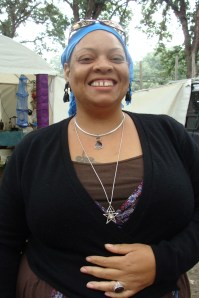
Crystal Blanton and Yeshe Rabbit at Sacred Harvest Festival – Interview

Crystal Blanton at Sacred Harvest Festival 2012

Two other guests from past Sacred Harvest Festivals are returning, Crystal Blanton and Yeshe Rabbit. This year a whole range of rituals are offered from guests, Harmony Tribe members, and community members.  Crystal and Rabbit are together offering a Ritual of Ancestral Healing on Thursday, Aug 7th.   Yeshe Rabbit is offering a featured ritual Friday evening Aug 8th,  “Dancing with our Demons”, before the annual Rangoli ritual.  I talked to them together on a Google hangout.

Advance Registration for Sacred Harvest Festival ends tomorrow at midnight, Thursday July 31st. Patrons can register at the gate in Albert Lea, Mn for a day, weekend, or the full week Aug 4-10th.

Yeshe Rabbit

What is the ritual that you are offering together?
Rabbit: We are very excited about the ritual we are doing together,  the Ritual of Ancestral Healing. We recently heard a lecture two weeks ago together that was so wonderful.  It was with one of Crystal’s mentors,  Dr Joy Degruy,  who speaks about the racial and ethnic underpinnings that have formed American culture.  There are these invisible threads of racism twined within everything. You don’t see them until you pull back the cloth and reveal the threads that are holding it all together.  I am so fired up for this ritual after going with Crystal to this eye opening lecture.

Crystal:  Doing something like this together is a step at looking at some of the many layers that keep us stuck. It is opening up conversation and connection,  extending the olive branch;  not necessarily through each other but through our ancestors. It is connecting in a way we don’t normally get to in our normal walk of life.  We will be acknowledging the many layers of societal hurt,  community hurt, and how we impact one another. I am excited about it as a way to open another level of work, and acknowledging it in a way meant to be healing. Not just ripping the scab off,  but acknowledging the fact the scabs and scars exist.  Loving those scars and loving our past through one another as a result of that.  I am really excited about it for those reasons.

You are offering this in the mainly white Midwest.  Does that make it different?
Crystal: I think it makes a huge difference because it is not often we get to offer this in other areas that may not have the diversity of places like the Bay Area,  and get a chance to  explore these things, in this way.  This is something very unique that both of us can bring to the table, and that otherwise people may not have the opportunity to participate in.

Rabbit: When I have done this sort of work before, one of the things I have found is that white people feel that they can only talk to people of color about this issue. Sometimes we really need to be talking to each other about it. While our sisters and brothers of color in the Pagan community are often amazing resources of information and experience that we can learn from, it is not always appropriate for us to ask them to teach us everything.  By gathering groups of people together who are white to talk together with people they know and trust, in a creative environment of trust, we are hoping that people who are white will engage with us, and each other to take responsibility together for learning about race and ethnicity.  I know some of the people who live right there in Minnesota also have persecution in their ancestral past, that may be different than the type of persecution that Crystal’s ancestors may have faced.  Certainly different that my ancestors faced in Eastern Europe. It is still relevant because what we are coming to the table with is to take responsibility for what we can do, what we can learn from each others experiences.

Crystal: I am excited about it. There is more diversity there than one might assume at first glance.  At the same time, even knowing that, the experience of people of color is different for people of color walking into a place that is perceived as a lily white area.  What that brings up , understanding that, and having that kind of dialog  in an open and loving way is so important. We plan to back up that kind of dialog with something that is magical and supportive. This is something we don’t often give ourselves permission to do,  to come to the table as we are, and work together for collective healing.  We don’t have to, it is not a blame game, it is not making people feel they have to take accountability for something that they don’t relate to.  It is dissecting a little of it together and than backing that up with magic. Part of why this is so special is it would be totally different if we were doing this in another location.

Rangoli Ritual Ground Design

What is your Friday night SHF ritual, Dancing with our Demons about?
Rabbit: In Tibetan Buddhism you have various classes of beings that you encounter. In the Dharma view you have choices. You have rituals that will banish those demons, and rituals that will feed those demons.  In this case I am really referring to a shadow part of our personality or psyche that comes forward, or a vexatious situation, this is a demon. It is a bad thing,  some thing we deem a “bad” collection of energies. When we encounter those we are soul tied to decide, are we going to banish this, try to fix this, or try to feed this. When we are in this mode of trying to either banish, fix, or feed one of the things what often happens is we are not being present for the lessons that thet demon is teaching us in the moment.  Dancing with our Demons is a ritual to bring forward and embody some of the hardest lessons that we have had to learn from this year,  and dance them into healing, and dance them into awareness. Not necessarily seek to banish, fix, or feed any of it, but just to be moving with it. This movement based meditation will help us become aware of them and so learn from our demons.

Another workshop you offer is about the Dharma Pagan?
Rabbit: In this session we will start with a chanting session so everyone can come and benefit from the experience of a chanting practice. We will talk about the notion of the Dharma, and how I relate that to what in my Pagan practice I call magic.  It is the universal force that flows through all things.  We will talk about where my practice overlaps between my Paganism and my Tibetan Buddhism. This so perfect because after we leave you all we move on to what is like our pilgrimage. The first leg of the pilgrimage is the Pagan one to Sacred Harvest Festival. Then the second and third legs are first in Colorado at the Buddhist monastery, and then in Tibet itself. These are the Dharma voyage of the pilgrimage.  This workshop will be a great time to talk about that in terms of the structure of my beliefs.

Crystal, your Tuesday workshop, “Embodying Cultural Archetypes”, is this preparation for the ritual with Rabbit or a separate topic?
Crystal:  In some ways it is a separate topic, but there is some intersection there. Initially it is something I am working on,  work that I am doing independently as a writer and spiritual person. The Ancestral Healing ritual idea came about and they complimented each other.  Though I  didn’t plan them together, they will probably work in that way.  I am delving into the marriage between culture and our spiritual practice.  How we show up in our spirituality. It is important to acknowledge and honor all the many different layers of privilege and gratitude in our practice. Sometimes there is a negative viewpoint when someone brings up the idea of privilege, at least that is the perspective.  In reality we all live with privilege and there is an intersectionality with privilege. It is  important to understand and talk about how that feeds into gratitude. How we can acknowledge the things that we have,  and do so alongside other things that are very challenging for us.  How we can make that part of a balanced perspective and practice for us so that we are moving forward with gratitude. For me they are very closely related to the theme of the whole festival. How can we be grateful if we can’t acknowledge e what is happening within our life.

Are Pagans class aware as a group, Is this about class?
Crystal: I do think we struggle in that area. In some ways we are class aware but in other ways my perception is that we struggle with the many different layers of what makes us a whole person and not just a Pagan.  It is in the evolution of any community. You start with one person and then it spreads out and spreads out.  We add to it and then have a different awareness and understanding.  At this point we are expanding our understanding around issues like class, racism, gender,  and how those things make up the Pagan community.  We ask does our understanding enhance or take away from our spiritual practice?  We are growing in that way. Not all Pagans are poor,  but not all Pagans have a lot of money either.  It is a struggle to wrap our minds around that. Even though we are Pagans we are also just people who are struggling in different areas. Bringing attention to that just makes us stronger.

You are offering a Community Gratitude Restorative Justice Circle on Friday, what does that look like?
Crystal:  Because it is focused on community building we will do some interactive things differently than at the other restorative justice circles I have done there before. It will be the same format but different. I don’t want to give too much away, but one of the activities we will be doing will leave the community with something tangible that has a piece of everyone there. You can choose what to do with it, whether to put it on your website, or return it to the festival. I really want to leave something tangible and walk away so when anyone sees it they will remember, remember how incredible it was to build community in that way.  I am excited about offering it, I did something similar at Pantheacon a few years ago.  There it was a really great experience and I m excited to see how it works for Harmony Tribe at the festival.

It is such an honor to be back there at the festival for a wonderful theme like gratitude, when I feel so much gratitude for everyone I have met in Minnesota.


Yeshe Rabbit and Crystal Blanton  will join Tony Mierzwicki for a week of workshops and rituals at Sacred Harvest Festival, August 4-10th near Albert Lea, Mn.  Advance registration closes this Thursday, July 31st, but is available for a week, weekend, or day pass at the festival gate.


Nels Linde

~ Nels is a council member of Harmony Tribe, sponsor of Sacred Harvest Festival

Tony Mierzwicki, Guest at Sacred Harvest Festival – Interview

Tony Mierzwicki

Tony Mierzwicki is one of three national guests appearing at Sacred Harvest Festival (SHF)  beginning Monday, August 4th near Albert Lea, MN.  Tony is the author of “Graeco-Egyptian Magick: Everyday Empowerment” and was also a guest of  SHF in 2008.

Tony is from Austalia but spends much of his time writing and lecturing in Southern California. I talked to him by phone.

Your expertise is in Greek Religion, what have you been up to lately?

I have a book coming out in December called , “Hellenismos: Practicing Greek Polytheism Today” . It is a book that reconstructs the practice of Greek religion and updates it to the current day. It is the first book to come out from a main stream publishing company. Every other book has either come out as an academic text or has been self published. This will be a practical text published with Llewellyn. I am a student of Greek religion and I am trying to make it more accessible for those people who are interested. There does seem to be a fair amount of interest in Greek religion at the moment. There are all sorts of Hollywood movies coming out, like Herakles and about other figures of Greek mythology. There would be people out there wondering how the Greeks venerated their Gods. This book will allow people to venerate the gods in a spirit of how the ancient Greek went about the process. There are a number of things that the Greeks did that we cannot do. We are not going to bring back public animal sacrifice, or slavery, or the subjugation of women. Every religion modifies and changes as time goes on. What I am trying to do is look at ancient Greek religion and come up with my best guess of what it would look like today if it had continued since ancient times. That is the spirit behind the book.

This is based on my own experience, but I also lurk on many Greek based electronic forums to see how other people practice Greek religion, and the issues they are having. There are a number of misconceptions that people have, and I have tried to address those issues. The book is heavily based on source texts, with over 400 footnotes that people can refer to as my primary and secondary sources. I look at the book as “factual” but different folks looking at the same data and material will look to other directions or disagree with the practice outline.

Is Greek  reconstruction a growing part of the Pagan movement?

It is a slowly growing part of the Pagan community . People who are drawn to the Greek religion tend to be very scholarly. They tend to consult original texts and get very passionate in their interpretations. There are many intelligent people practicing Greek polytheism. There are some people who believe you go through the motions, performing rituals perfectly, but do not expect any personal interaction with the gods. Others believe you it is all about a personal interaction with the gods. That is my belief. Unless you can feel the presence of the gods you are not really getting the most out of your practice.

The Greeks did not have a word for religion. In this day and age we tend to think of religion and secular life as two separate things. We go about our daily lives and may get involved in some religious practice occasionally. Christians may go to church on Sunday, but the rest of the week they are indistinguishable from the rest of the community. Pagans may venerate their gods on certain days, full moons or the eight Sabbats, depending on what they are into. For the Greeks, venerating the gods was something they did everyday. They would not think of beginning any venture unless they called on the gods first. The practice of Greek religion was integrated seamlessly into everyday life. We think of religion as being separate, but then it was considered a crime to disbelieve in the gods, or be an atheist. Everyone went to temples constantly and engaged in various sacrifices. There were particular rituals that took place on a city level. Household performed their own rituals, Guilds and trade groups performed their rituals. They were all varied and different. The principles remained the same but the nuts and bolts of how they did ritual varied.

The description of how Greeks practiced religion in all aspects of life sounds a lot like much indigenous practice?

One of the early theories of how religion developed is that it started off as a shamanic practice that became more institutionalized and then turned into religion. If you look at many indigenous tribes their gods have a very real presence. The gods are around them constantly and interact with them frequently. The tribes depend on the gods for everything that is good in their lives. The gods provide sunshine and rain and produce a bountiful harvest for them. They are constantly working with the gods, there is no idea of separation from the divine. This is something you also see with the Greeks.

What are you bringing to Sacred Harvest Festival next week?

The heart of my presentation is a series of three workshops that begins with The Practice of Ancient Greek Religion Today.

The second is on Greek Nature Deities and Gaia Consciousness .  It is about the interconnectedness of us and everything around us. I wanted to bring in the idea of Gaia consciousnessbecause it is a thoroughly modern concept that talks about how everything is interconnected and integrated.

The third workshop pushes that further and talks about how all of this impacts our health. The things we do in everyday life have an impact on ourselves and everything around us. One of the problems in modern society is that many see themselves as separate from the world. They think they can exploit the riches of the world and not suffer the consequences. I will be pushing the idea of working in harmony with the world, working with sustainable faming practices, sustainable energy and the like. I will talk about how this then also impacts on our health. The workshops form a cohesive series together and I am very grateful to be able to offer these three workshops as a series.

Will this be of interest to those of many different paths?

Absolutely, I will try to talk in generalities about these topics, but when it comes down to it one of the things that most Pagans have in common is a deep connection with the planet, the world around them. Regardless of the gods that they may feel closest to, most of us realize that we are integrally connected with the planet and that our decisions effect everything that happens around us – the butterfly effect.  This proposes that every little thing that we do, can wind up having a much larger effect around us. The more people become responsible in how they act, the better things will turn out in the long term for us. A precipice is approaching where we start running out of fossil fuels, and pollution is so bad we can’t breathe the air or drink the water.

My fourth workshop will be about ancient curses and bindings. This will be an overview from an academic sort of viewpoint. It will give people an idea about what kind of activities took place so they can see the darker underbelly of our community from the vantage point of the past.

The last workshop will be about the god Set. For a lot of people Set is thought of as an evil god, a prototype of the Christian devil. He has been demonized over the years. When one people conquers another they demonize the gods of the other. In this case Set was a very significant god in ancient times. There are various texts which talk about his importance and describe him as a benevolent deity. Once the worship of Osiris came to the ascendancy, Set was demonized. I hope to present some balance and provide another way of looking at him. He is a powerful god, but not really evil. I want to share what I have found in my research about him.

When were you last a guest at Sacred Harvest Festival?

This was in 2008 and had a fantastic time! I was made to feel very welcome. One of the things I really liked was there wer activities for all ages. There were many children and there wer activities for kids, teens, and adults. There was a strong family environment for people who attended with their kids. It was nice to have a festival where you could actually sleep!. Many stayed up late but it was around campfires, singing, enjoying stories and a drink or two together. The whole event had a very family kind of feel to it and I felt blessed to be there. I feel blessed to be coming out yet again!

I firmly believe that whatever path you choose has to be the path that resonates with you, the path that feels right for you. Unless you have found a specific path you absolutely don’t want to deviate from, it is always good to see what other people are doing and perhaps learn little things that you can integrate into your own practice from them. I am simply bringing things I have learned in the past couple of decades in the hopes that attendees can get something out of them to integrate into their own practice. There may be people interested enough in what I am doing to engage in the practice of Greek polytheism or perhaps Graeco-Egyptian magick – the subject of my previous book. What I have found from running workshops based on my first book is that very few people will choose to practice exactly as it is presented in the book. People tend to pick out bits and pieces from it and integrate it into what they are already doing. That is fine because it is all about finding things which resonate with you. When I was starting out I was trying to learn everything I could from those around me. There were things that would just feel right, and others that didn’t quite feel right. This approach ensures that eventually you end up navigating your own path.

There are so many gifted speakers this year sharing their experiences and knowledge. That is what it is all about, learning from each other and sharing our experiences. We can then all pass what we have learned and pay it forward. I can’t help those who helped me in the past but I can help those who come after me, and I encourage others to do the same.

Tony will join Yeshe Rabbit and Crystal Blanton  for a week of workshops and rituals at Sacred Harvest Festival, August 4-10th near Albert Lea, Mn.  Advance registration closes this Thursday, July 31st, but is available for a week, weekend, or day pass at the festival gate.


Nels Linde

~ Nels is a council member of Harmony Tribe, sponsor of Sacred Harvest Festival

Ed Fitch at Heartland Pagan Festival – Interview

Ed Fitch before his workshop on the Magick of the Seven Seas.

Ed Fitch before his workshop on the Magick of the Seven Seas.

Edward Fitch is a Wiccan High Priest of the Gardnerian tradition and was a leading figure in the rise of contemporary Wicca and Paganism in America.  Fitch was an early initiate of Raymond and Rosemary Buckland (initiated by Gerald Gardner’s home coven) after they set up the first Gardnerian coven in America. Fitch also helped to organize and chaired two Pagan Ecumenical Councils to establish the Covenant of the Goddess (COG) as an international umbrella organization representing Pagans. Through the 1980s Fitch continued to perform as a Gardnerian High Priest, but his researches also led him to initiation in a number of other traditions and orders, including:  Faerie faith, Mohsian, the Order of Osiris, the Order of the Temple of Astarte, Norse, and Ceremonial magick.


Fitch is the original author of “Magical Rituals from the Crystal Well”, the Pagan Way Rituals, and two classic underground books on American witchcraft:  “The Grimoire of the Shadows” and “The Outer Court Book of Shadows” (later combined by Llewellyn Publications to be published as “A Grimoire of Shadows”) as well as the Norse volume,  “The Rites of Odin”. He also wrote (uncredited) “A Book of Pagan Rituals” and is the author of the forthcoming “Revised and Updated Rituals of the Pagan Way”. (He created the original “Pagan Way” ritual system in 1972.)

I had the chance to chat with Ed before one of his workshops as guest at Heartland Pagan Festival, near Leavenworth, KS.

What was your introduction to the craft like?
I had been looking for the craft for a long time, and had been totally isolated from it. I was in Baltimore and was getting restless.  I would go out to the airport, and go to their bookstore which featured science fiction. I was out there flipping through books and came upon “Sign of the Labrys”  by Margaret St. Clair  and words started jumping out at me; “moon power”, ‘priestess”,  “coven”. I started some research on what was this “Wicca”.   This was 1963 and there was nothing in the states that I knew about. I thought , ah ha, here is someone to contact, but how in the world do I do it? It took me a year to figure to contact the publisher. I did and got an invite to drop in and visit from Margaret and Eric St. Clair. I visited them in Richmond, Ca and thought nothing of the fact they had a ceremonial sword on the wall and the living room had a triple circle inscribed there in bronze. They were brilliant people and we had great conversations. I did not know but afterward they sent a letter about me to Ray and Rosemary Buckland in Long Island. I went back into the Air force and was assigned to Hanscom Air Force Base just outside of Boston. I began to visit Ray and Rosemary and very rapidly became part of the coven.

The very first time I was there we were chatting and it approached midnight. I was going to turn in and Ray said, “No, we will be doing a ritual. We will open the circle first and we will have you come in later on.”  They prepared a consecrating bath for everyone and he flipped me a towel and in his finest English accent said, “Here, this should soak up the blood.”  Everyone had their bath, and I had mine,  and went then all down and they left me sitting in the living room dressed only in my goose bumps. I could hear chanting and a little bit of laughter. I wondered what is this all about? I had done research and knew these people did not take blood sacrifices, but … just suppose that I am wrong?  After a while Ray came with his athame, in his devilish beard and mustache and said, “We are ready for you.”  At the dark entrance to the stairs going down I said; “After you.” and Ray said, “No, no, after you!”  I walked down the stairs into the complete darkness,  being very conscious that  someone was just behind be with a drawn blade. At the bottom a curtain was opened for me. There was the ceremonial room all lit in black light.  Suddenly a beautiful naked woman leaped out at me with a dagger and said, “Yummy, fresh blood!”  I nearly had heart failure. I later discovered they were very charming people with a great sense of humor.

Did you continue to work with them?
Well for a time but eventually the Air Force sent me to Vietnam, and on to Thailand. I had little contact over there, but began the writing (1967) of the “ The Outer Court Book of Shadows”, published by Llewellyn. Some of my writing from that time has a bit of an edge on it because, well, I was being shot at from time to time!  I had been working with Ray and Rosemary for some time, and writing material for them.

Did you ever run a coven as priest, or do you prefer to work solitary?
I had an interest long before I was initiated.  Initiations were done in pairs at that time, male and female, and I did have a small coven for a while. I was in the active military and was sent all over.  My lady and myself ended up going separate ways.  I have since sometimes worked as a coven and sometimes on my own.  I find it is very good to work as a coven because you can exchange ideas, and do power workings with them. Solitary you get to study and meditate. People have personalities and there are sometimes conflicts. When that happens it is best to just ease away genially and then do your own research and study.  I like both ways of working.  I like working with my people over here on advanced work and like to bounce my ideas off my people. Of the people that I train that I think will be the best maybe one out of ten will be really spectacular. The others will be mediocre, and one or two will be toxic. I have never been able to judge human nature that well. There are advantages to the traditional Wiccan time of waiting a year and a day before an initiation. When I got started there was such a demand that people wanted it faster than that. My material was written so  people could get into it a good deal faster.

fitch1Do you believe in magic?
Yes, and I believe in gravity, even green trees and beautiful women!  A person doesn’t believe in it, one lives it. Like talking to a tree. I taught myself to link into a tree and get its life force, get its feelings.  I go to the redwood forests in California and wow, this thing is three hundred feet tall, and I am tiny compared with it. I was on a ridge line outside Los Angeles hiking alone and came upon a snag that had been killed by lightning.  I gave it an offering of water around the base, and put my hands over it and my head against it. I immediately got a splitting head ache, like I had been hit by lightning. I was communicating with something that was dead.  There was a consciousness there that goes beyond death. I found that trees are all interlinked, but that is another matter.

Do you have a vision of what Wicca and magic is offering our society for the future?
Wicca and Paganism are going to be spreading more and more. We are probably going to be seeing some of the initial effects of it with the green movement and things like that.  We are gaining more of an understanding of some of the deeper aspects of life.  When I was working for Westinghouse some forty or fifty years ago we discovered by experiment that there is an understanding of reality beyond reality, the Multi-verse.  Reality is flexible, you can effect it with your own mind. I have learned how to affect it with mine.  You have to roll and live with what is out there, live with the natural world.  I stay away from cities as much as I can, because they are toxic. I have a strong dislike for anything chaotic. It is interesting to experience life in as many ways as possible.

Do you consider yourself a traditional Gardnerian?
Gardnerianism is my home, and from there I expand outward. I really feel a person should get a start in one tradition or another, from there, go with your DNA. If you have Norse blood, great, if you have African, great, go with that. Some of my best friends are in the Roman traditions. After you have got the tradition down then you can branch out and try other ones.

Do you have a personal set of deities?
There are many, many manifestations of the Gods and Goddesses. The Garderians work with the God and Goddess, but when I am up in the mountains I may give an invocation to Thor.  If  I am near the ocean I may work with the Lady of the Seas, or Poseidon, or what the hell, even Davy Jones.  There is only one deity force but he or she has ten thousand names and more. Just pick the ones you can relate to the best. I like the Goddess because she is pretty, and very, very magical. As Freya, she kicks butt!

How have your travels and the spirituality you found there influenced you?
The reason I did the Odinist book is because I spent several summers in Denmark, Norway, and Sweden, and the British high country. The military sent me to the orient and I learned a bit of their view of things, and followed up on it with study. In Japan the oldest legend is that they were founded by the seven little Gods who sailed up from the south.  I still have a sculpture of this with the seven gods on their ship. Each has one  has one of the major aspects of civilization.  In Sumerian legend, Inanna wanted to get civilization started but her father had the seventy-two “Me”, magical scrolls, I think.  She sailed her boat up the river to the God, smoozed him and got him drunk, and then sweet talked him. She got all the Me loaded on her boat and sailed away before he knew what had happened. He was angry, but she had gotten the basis for civilization. I like Inanna, she was a sex goddess, a war-goddess, loved to go into taverns. She went down into hell, got killed and then came back again.

Where does your path lead you today?
I am going to continue writing because I want to get my ideas out. It helps people in their own paths and begins to change society in what little I can contribute to it. The royalties are trivial, but still good. Will I continue to work in a group? Yes, but I also continue to do researching  and reading and trying out new things. I have not lost any students as of yet, though I push the edge sometimes. I will have my elders coven come over and say, “Lets step on out, I want to have you do face and shape changing.”  I have a special technique that I have researched and written for this, and worked on for years with my ex-wife, Janine Renée . Through this you can change your appearance. You can actually feel the flesh and the bones moving and changing their appearance.  This is a trick, but the deepest part is what happens in the mind. Or lighting a magical flame. You have a candle and everyone concentrates on breathing the element of fire in and putting it there on the candle. It will light and the blue glow spreads all over, and onto your hands. This is great for healing, but that is yet another matter.

There are many things that I do not understand, but I am fascinated by them all. It’s a big, complex and intriguing universe of magic!


Nels Linde

Ivo Dominguez Jr at Paganicon – Interview

Ivo Dominguez Jr

Ivo Dominguez, Jr. is a visionary and has been active in Wicca and the Pagan community since 1978 and teaching since 1982.  Ivo was a founding member of The Assembly of the Sacred Wheel, a Wiccan Tradition.  He has taught at many gatherings, conferences, and venues across the United States. Ivo is also a professional astrologer, a well known as a ritualist, and author of many chants and songs. Ivo lives in Delaware, where he one of the owners of Bell, Book, & Candle, Delaware’s largest metaphysical shop. One of his passions has been to be one of the driving forces behind the New Alexandria Library project, which is rapidly approaching completion!

Ivo is a special presenter at Paganicon this weekend. Registration is available at the door, per event, per day, or for the Saturday ball. He was national guest at Minnesota’s  Sacred Harvest Festival in 2004 where he made his initial connections with this area.

How is the Alexandrian Library project proceeding?
Yes, it is being built. The weather has not been kind to us. The building is progressing as the fund raising is progressing. We have been clear all along that we want this built without a mortgage, with no debt on the project. If all goes well, and the weather holds, we will be ready to start painting and preparing the interior at the end of June and later this summer moving books into it. It is progressing slower than we would like, but in the long run for the sake of survivability, not having a monthly payment is primary.

In 1990 four of us bought the land and moved down there. The land is paid off. Groups take a long time to mature. We have deeded over the thirty acres that the library occupies. We are are progressively deeding over the balance of the property through life estates, so once we are all gone the entire property will remain with the library. Currently there are four houses on the land and the organization will inherit them all piecemeal over the course of decades. Once we owners are all passed there will be no real estate tax as Delaware doesn’t collect tax on 501c3 property. We as a group have several decades to ensure that there is a viable group within the non profit to keep and maintain this property.

Ivo Dominguez Jr with Macha Nightmare in 2004 at Sacred Harvest Festival

You were a Sacred Harvest Festival back in 2004, it will be great to have you back in our area!
I am looking forward to attending Paganicon. I start the morning with a panel discussion and then my voice workshop. In the afternoon I have the book signing, a ritual, and then another workshop.

What is the panel discussion about?
The early morning panel is called surviving in dispersion. This is I think still being defined. Part of it is how to survive as a Pagan in a non-pagan world, but part of it is also how to survive and thrive if you are say, in a rural area, or an area with a small Pagan community, or one with few resources. I am guessing we’ll also cover what it means to be the “other” within the broader community.

Do you experience community as an “other”?
No not at all. I think I was considered because being from Delaware, it is not considered a Pagan hot spot like Paganistan! What I hope to bring is some insight into how you create your own community, your own enclave. How to interact and engage with the local community that may or may not be Pagan. I have been active in my community for a very long time as one of the owners of the local metaphysical shop. I help organize the local Pride event and have contact with the local political organizations. I will bring the perspective that even if you are a very small percentage you can have everything you need if you engage with the larger community. The role of public Pagans in communities where there are not many with a public face may come up. Having a local shop if the police ever find something strange they always come to me to ask,  ”Do you know any thing about this?”. Where this discussion goes will depend on what questions get posed to the panelists. I would like to focus on how the survive and thrive in a small community.

What is the magical voice workshop about?
This will be a lot of work on how to use chanting, spoken runes,primal sounds, and why the voice is so powerful. Before we jump in we will talk about magical hearing,learning to listen magically. The only way to join your voice with other people is if you are really listening. I am looking forward to this workshop, I really enjoy it, People leave very energized from this workshop.

The Four Minds workshop is a ritual?
Yes, “The Four Minds Ritual” is a sort of meditative ritual. This will not require a whole lot of mobility. In the beginning we will walk the to set boundaries for the space doing some free form toning. For the bulk of the time once they have in mind what they wish to explore or contemplate we will be seated or on the floor with eyes shut and traveling inwards. The ritual is a guided journey through the four elements and then back to spirit with the intention to explore a particular aspect or seek guidance on a particular thing for each person. It is a ritual, mainly internal but with some external portions of it.

What is the Karma workshop about?
The Structure of Karma is about exploring the mechanics of, not so much what karma is, but what karma does. Which things cause it to work or not work. The celestial mechanics of karma, lifting the hood to check how the laws of hermetics work to create cause and effect, causality and synchronicity. It sounds strange but it is an exploration of the engine driving karma, as opposed to whether something is good, bad, or indifferent or how do I escape or alleviate karma, or is it punishment or fate? We will explore individual and collective karma. What we do creates ripples out there. It doesn’t matter whether you believe in karma or not, this is cause and effect and change. If you make choices, if you have emotions or thoughts, you are putting into play a whole chain of cause and effect on the linear side. You are adding a whole web of synchronicity on the non-linear side that will pop up into the world as things that manifest. Karma is just a catchall word for the things we do that drives the engine of manifestation.

Construction of the New Alexandrian Library

What is your vision of what we need to accomplish in the next twenty years?
What matters to me is that we leave behind a viable culture and a real infrastructure as Pagans. Infrastructure  is the single most important next step. Things that are tangible and real in the physical world are infrastructure. It could be a building, be land, be a library or a shrine or temple. A large event like Pantheacon is infrastructure too. It takes a large number of individuals, money, time, and energy to create this Brigadoon type of event that lasts only a few days. Three thousand people intersect in a great Pagan crossroads, like a Pagan United Nations session. This is also fragile, it takes very little to destroy an event. It take a lot to maintain, and requires cohesiveness of a group to continue.

How we hope to maintain things like this is by this example. We put on an event every few years called Between the Worlds. In 2015 it conflicts with a smaller annual event in the Mid-Atlantic area the Sacred Space conference. We could just go forth and divide the teachers and participants between the two events. The smaller group would probably suffer financially and possibly become less viable. Our two boards met and decided to hold a joint conference. Both events will take place in the same hotel and admission to one gets you admission to the other. We have worked it out to be fair and keep both events, the infrastructure viable.  Cooperation is possible, it is not easy. It is messy, but it can be done.

Ivo speaking at library ground breaking.

Paganicon Begins THIS FRIDAY   March 14th  7pm – Sunday March 16th 4pm at the Doubletree Park Place St. Louis Park , MN. Ivo Dominguez will be presenting at four events Saturday, plus a book signing.  Registration is available at the door, per event, per day, or for the Saturday ball.

Nels Linde

Deborah Lipp at Paganicon – Interview

Paganicon 4 begins this Friday

Deborah Lipp

Deborah Lipp

March 14th  7pm – 16th 4pm

at the Doubletree Park Place

St. Louis Park , MN

Deborah Lipp and Oberon Zell-Ravenheart are Guests of Honor

I got the chance to interview Deborah Lipp about her appearance beginning Friday at Paganicon

You will be sharing the opening remarks for Paganicon with Oberon?
Yes, we have known each other for many years. We discussed the talk and were on the same page so we decided to work together on the keynote address. The talk will be about our Pagan history, its importance, and how to preserve it, and to know who we are, and then lead into some ideas about the future.  I published a memoir about a year ago, and now Oberon has one that has just come out. I was particularly affected by the death of my ex-husband (Isaac Bonewits), and felt very strongly the importance of history, of knowing who we are and who we came from.

You also have a long time history of participating in the Pagan festival movement?
I have been a festival participant quite literally from the beginning. I went to my first festival, well, right before I was initiated at age 21. Before my son was born, I went to 3-4 Pagan festivals a year. After his birth it was more difficult and I have slowed down, but I have been going to festivals for more than 30 years. Festivals were something that my high priestess, as a young witch, was very adamant about. Going to festivals was a way of meeting people, of exchanging ideas, of learning cool new chants to use in ritual. It was important. This is a part of Pagan history, too. As a young Pagan entering the community and you may not value festivals because they are corny, people dress funny, and you have to sleep in a tent. They don’t understand that the existence of the festival movement, which began in the eighties and didn’t really take off for another five years, transformed the face of the Pagan community. It is one of the most significant contributions to the Pagan community of the last thirty years. Before there was an internet, there was a Pagan festival movement.

Has the role of festivals changed over the years?
Electronic socializing has become really important. The fact that there are now so many ways to communicate as Pagans has diminished some of the importance of the festival movement. Now ten years after the rise of festivals we have what I would call the solitary movement. Prior to the publication of “Wicca: A Guide for the Solitary Practitioner”, people were not solitary by choice. People were solitary because they could not find other people to work with, period. A solitary was a person who had not yet found a group. The idea that you can be solitary because you want to be was facilitated by the festival movement because you can be solitary and at festival still share ritual with others. There you have a community that you can connect with. People make fun of it, you know, Beltain and Samhain Pagans, party Pagans, and such. The fact is coven work is not for everyone. The festival movement provided a source of different models for how to be Pagan. Maybe you have a 11 months  private solitary practice and then one month at festival and spend time connecting with your community. For those of us who came up through a coven system, festivals were our first insight into other ways to express Paganism, and how to relate to our community.

What about the beginnings of indoor Pagan conferences?
They have been around our community just as long as any festival. The first indoor festival was Gnosticon. The convention style event has always been a part of the mix. Every festival type event will have its own particular flavor. Some are intellectual, or ritual “heavy hitters”. Other may have a music or arts focus, or be more “party” oriented. Some festivals are more geek oriented and have a relationship to that culture in their personality. I have been to festivals all over the world, from Australia to Canada to Brazil. The people pretty much all look alike, they all look like Pagans. You feel at home and a sense of community, but the style and personality will vary.

What will the “Way of Four” workshop at Paganicon cover?
This will be drawn from my book, The Way of Four, about the four elements.  The workshop will cover, “What are the four elements. What parts of life do they apply to? How do they affect you? How do you work with them? How do you use an understanding of the four elements to enhance your quality of life?” The attendees will help guide the direction that we go in during the workshop. It is sometimes very interpersonal and questions about elemental issues and ideas may direct the focus of the workshop. First and foremost it is about a basic understanding of the four elements. The four elements are the building blocks of all occultism. I am passionate about that. You cannot read the Tarot, do high magic, or use astrology without understanding the four elements. They affect not just Wicca or magic, but nearly everything in the occult. We will come away with a deep set of correspondences with the four elements and then learn to apply them to different situations. This is one of my favorite workshops.

You wrote two books on the Way of Four, though.
When I wrote The Way of Four, I was trying to be very complete. Write down everything about the four elements, four elements in meditation, in nature, in your love life, in your home, in work. This how I write. As I was doing this I eventually got to “spells” of the four elements. As I worked I several times said, “You know I could write a whole book about this.” Out of this came the book “The Way of Four Spellbook” which is specifically about spells and magic. It is really a “how to” instructional book rather than a recipe book, each spell serves as an example of the lesson just discussed in the book. A sex magic spell would fall under the element of fire type of spell. We can just mention that in the interview because then everyone will perk up and listen and want to attend the workshop!

The “Heroes Journey” workshop centers around the Rocky Horror Picture Show. Are you a fan?
Yes I actually performed in it at the Eighth Street Playhouse in New York City, back in the day. It was a floor show or, as it now called, a “shadow cast”. You perform the movie live while the movie is going on. I am very interested in pop culture as a modern mythology and a modern form of religious expression. Rocky Horror, with its passionate cult following, is the perfect event to have this discussion around.

What do bring to Paganicon that will attract us?
First, I talk a good game, I hope you have noticed this! I am very entertaining, part Wicca, part stand up comedy. People do appreciate that because most writers are introverts. I am very extroverted, very talkative, and that is fun to experience. You get the kind of knowledge you expect from someone who has written six books but I’m also someone who is used to being interactive and thinking on my feet. Many writers can’t take Q & A and have to work from a prepared text. I am not like that. I would never call myself an elder because I am still youthful, and very cute! I have been in the community for thirty years and know what I am doing. I have been all over the world and have a deep knowledge and experience about what I know. I write about traditional Wicca and Paganism as understood by a traditional Wiccan.

Paganicon begins this Friday at 7pm and runs through Sunday at 4pm.  Located just five minutes West of Downtown Minneapolis.

Featured Friday evening is the Keynote address and the opening of  “The Third Offering: A Sacred Gallery Space Arts”, and on Saturday at 8pm the “Embracing the Elements Equinox Ball”.

Registration is available for the whole event, by the day, or just for the Saturday Ball at the door. Lodging at the hotel is still available and extra.

Nels Linde