UMPA celebrates six years, debates a seventh

As the Upper Midwest Pagan Alliance,  a federal 501c4 service corporation, prepares to celebrate their sixth anniversary at their biennial meeting this Saturday, they’re also contemplating if UMPA should disband or if it can be revived through an influx of new members and new leadership.  That question will be discussed while attendees enjoy music, food, and dancing.
.
In late 2006 and early 2007, when Pagans across the nation were banding together in the VA Pentacle Rights Quest, the Upper Midwest Pagan Alliance (UMPA) was born in the Minnesota/Wisconsin area. It’s conception was sparked by an unlikely source – a local curmudgeonly radio personality named Joe Soucheray.   In December of 2006, Soucheray was reading a news article about the Pentacle Quest on his afternoon show, Garage Logic. While he said that soldiers who gave their life for their country should get whatever they want on their headstone, he did get some mileage out of poking fun at Wiccans. He noted, jokingly, that Wiccans have a PR problem and they need to do something about it.

First, outrage swept the local Pagan community, followed shortly by thoughtful discussion.  “Soucheray was right, we should be doing more,” said Nels Linde, UMPA’s former chairman. “We have a PR problem in that we tend to be quiet people. We don’t get out there and say who we are or what we do. People think we’re out dancing in the woods in robes.”

Nels Linde and Judy Olson (among others) used their years of experience in group leadership and UMPA was born. According to the group’s website, “Our immediate activities focused on this issue, culminating in the Pentacle Rights Ritual at the Minnesota State Capital, in a blizzard on Febuary 24th, 2007. In a short 40 days we organized, produced an informative color brochure, made press contacts, and secured the Capital grounds for the event.”

The ritual, which included the formation of a human pentacle, was well (and favorably) covered by local andnon-local press.  After the VA settled the lawsuit and approved the Pentacle as Gravemarker for Wiccan Veterans, UMPA took up other projects.

UMPA Officer Bress Nicneven says, “We’re still sending solider packages to the middle east, from donations by patrons from Magus Books.  We still clean a stretch of I-35 E twice a year. We do ‘Meals on Wheels’ to the elderly during the holidays – annually. And feed the homeless when we have enough volunteers available.” Nicnven says UMPA is a relevant organization and he’s “excited about the potential that is UMPA, in the months and years to come.”

The organization notes that while over 300 people have been involved with UMPA over the past six years, membership has dwindled and that is prompting leadership to ask members and the community, “… does this mean UMPA is no longer needed? We don’t know. This is an opportunity gather for a great meal, entertainment, and to join in and discuss the future of UMPA; either find some new leadership and participation, or dissolve the organization and pass on any funds raised to another non-profit.”

The festivities this Saturday kick off with a tribal dance performance by Kamala Chaand at 4:15 followed directly by traditional Norse musician Kari Tauring and then the Bourgeois Bohemians, a fusion dance troupe, performs.   The Biennial UMPA meeting starts at 5.30pm where members are encouraged to add their vision for UMPA’s future and elect a new council.  Attendees are invited to enter the Best Chili and Cornbread of Paganistan contest and everyone present gets to sample the entries for dinner.  While entry to the event is free, the meal is a $5 suggested donation for non-UMPA members or free for members.  Everyone is welcome to the event.

Event information:

Saturday Feb. 9th 4-7pm
At the Living Table UCC
4001 38th Ave S, Minneapolis, MN 55406 – lower level
Handicapped Accessable, two blocks off Minnehaha bus line
Meal $5 by donation or free with UMPA Membership.
Choose the best Chili and Cornbread of Paganistan.
Bring your favorite Corn Bread or Chili to join in the competition (enough to feed 50 people a sample portion)
Admission is free and everyone is welcome.

Am I a Pagan? – Editorial

Photo: kitchenwiccan.com

Quite a few people anguish over their personal answer to this question.   We should all know what to say, but usually stammer around a little and say something vague.  There is a discussion among Pagan intellectuals about whether your beliefs and practices can safely fall under the broad definition this term offers.  The modern definition of Pagan arose with a pretty Wicca-centric focus, so the further your practices and beliefs get from that, the less safe this umbrella term may feel.  Can we agree to a term or definition that works better in the future?   I don’t know.  Nearly everyone has a different answer, when asked, “So what is a Pagan?”   I see the value for those who embrace the word in finding a good definition for the term we can all use.  A definition that is accurate and inclusive, and doesn’t offend anyone.  I will leave that to others to technically work out, it doesn’t interest me that much.  I just like the term Pagan.

I grew up in the 60’s and 70’s when the word “Hippie” was kind of similar.  For some it conjured up dirty, disheveled, long-haired lazy people, self-absorbed in mind expanding drugs and having loose moral standards. I never minded when someone called me one as hate speech.  I knew they meant one thing, but it meant something else to me.  I embraced the label for its vision.  I saw it as representing a new way of looking at life, as re-assessing of what was important, and letting go of the expectations of others and our society.  I liked the “Peace and Love” platform.  I soon learned in personal application it often meant “my” peace, and “my” love, as  interpreted at any moment. The Hippie movement quickly degenerated, maybe because it didn’t have a clearly articulated definition that guided and sustained people who claimed the term.

Continue reading

Crossed Quarters – Guest Editorial by Lisa Spiral

Most Pagans are aware that the eight sabbats of Wicca are an artificial construction. They combine festivals of hunter/gatherer peoples with festivals of agriculture and animal husbandry. When you add to that an international following and crazy modern scheduling you have a practice of worship that is truly Neo-Pagan.

Our quarter celebrations, the solstices and equinoxes, come to us from people’s who understood astronomy. These are real and measurable events in time and space. The tools and precision of measuring when these sabbats occur have changed over time. The events that they celebrate are fixed.

The cross quarters, however, are seasonal celebrations. They mark events of weather and harvest that happen when they happen in the local area. We know from the names we call them by: Imbolc, Beltane, Lughnasad, and Samhein that these are sabbats from more northern climates. These are celebrations of a people who were dependent on an unpredictable weather.

They may have marked migration cycles. They may have marked the end of a harvest season. They may have marked blooming plants. They may have marked fertility of farm animals. But these kind of events occur at different times in different places in different years.

Our calendars come to us from the Romans and the Roman Catholic Church. When these local festivals were assigned patron saints and attributed to saints days on the calendar they became more fixed in time. Of course the church calendar has changed once or twice over the last several thousand years and saints come and go. Continue reading

Freedom to Marry rally seeks clergy involvement

FreedomtoMarryDayMinnesotans United For All Families hosts a rally at the Minnesota State Capitol building to support legislation allowing same sex couples the ability to marry.  The rally is titled the Freedom To Marry Day and is scheduled for February 14th.  Organizers are also seeking interested clergy to take a greater role in the rally.

Minnesotans United says this event is, “a key first step in working with state legislators to ensure that in 2013, Minnesota state law is changed to reflect our shared belief that loving and committed same-sex couples should have the freedom to marry.”

Organizers wish to show that support for enacting laws to legalize gay marriage is broad-based and diverse so attendees are encouraged to display religious, political, or group affiliation while at the rally.  PNC readers can find more information, to RSVP, or for Pagan clergy to contact Minnesotans United, here.

In Syria and Egypt, Pagan voices fall silent

Areas where there is political turmoil or fighting are often difficult places for even those in the mainstream of a culture to live in.  It’s even harder for people on the fringe of society as they face confusion, uncertainty, deteriorating living conditions, and daily fear for personal safety.  Those set apart by ethnicity, language, sexual orientation, political views, or religion are the most vulnerable to loss of property or even loss of life.  In Syria and Egypt, two countries currently experiencing political turmoil or civil war, one by one Pagan voices have fallen silent.

There are eight Pagans, three in Egypt and five in Syria, that I have regular contact with online.  They had always been cautious about revealing their religion to people within their country and expressed dismay over their isolation, but they were happy to talk online and wanted to know what American Pagans, especially those who practice Mesopotamian or Kemetic religions, were doing.

Egypt
The Egyptian Pagans, who were elated at the fall of Muburak, expressed hope that a truly democratic government would emerge in Egypt.  Then,  concerns crept in at the increasing power of the Muslim Brotherhood.  Karim saw the Brotherhood as a threat to both his country and to him, as a Pagan, personally.  Over the past seven months, the lag in communication grew as he became more politically involved and went to rallies and protests.  He expressed fear that pagans and other religious minorities were in increasing danger and that the Christians would sacrifice people like him to the Brotherhood to appease them.  The other two Pagans I communicate with followed a similar pattern.  Elation, followed by concern, followed by fear and determination.  Then silence.  I have no way of finding out if they are simply too involved with the political turmoil in Egypt to respond, if they are keeping quiet to avoid suspicion, or anything else.  It’s been three months since I have heard from any of them.

.
Syria
The situation in Syria appears to be more grave, according to the last messages I received from the five Pagans I chat with regularly.  They spoke of the fighting and how places looked like Beirut,  buildings just shells of themselves, rubble blocking the streets.  They detailed neighbors going missing.  Islamic fundamentalist patrols that monitor behavior and took violent action against people who violated rules and customs. They debated fleeing, worried about being outed as a Pagan, and started destroying or burying altars.  Three began attending local mosques to show their devotion to Islam.

email for article

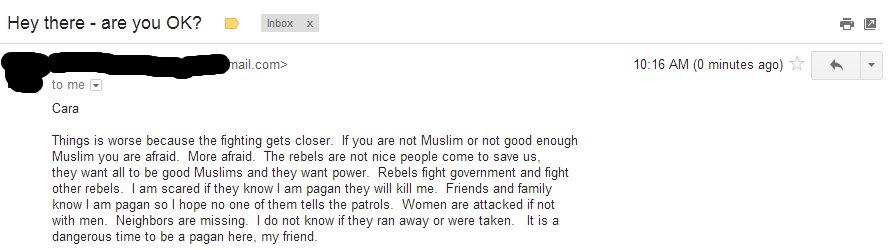
Last email received from Yana.

Yana dropped off first.  I last heard from her in June of 2012.  Bayan, another Syrian Pagan, also hadn’t heard from her but said fighting in her area was intense.  He said he had seen patrols targeting young women and men, beating them and he said it was rumored they were raping them.  He thought perhaps she fled to a safer area or was silent to avoid detection.

That was the last email I received from Bayan.  Like dominoes the other Syrian Pagans went silent.  No emails or texts.  No word on their safety.  I keep hoping I will hear something, but it’s been several months and still no word.

I reached out to a Pagan in Lebanon, Adon, to see what he has heard about his coreligionists in Syria and Egypt.  Although he’s not in the same country, he’s much closer than I am.  I asked Adon if he had heard from Pagans in Egypt and Syria.

I haven’t heard of my pagan friends in Syria for a while too now, i know at least three of them who moved to other countries, especially Algeria, and United Arab emirates, but i have lost their contact in the process. The others are still silent, so they’re either disconnected, moved from the country, or worse. It’s hard to tell at the moment, pagans in the Near East were already several secluded clusters of individuals who don’t have a lot of contact with each other before everything started to happen. This is the case even in Lebanon where it’s relatively easier to be open about one’s religious identity.

I didn’t had any contact previously with Egyptian pagans, but they’re probably fine, but everyone in Egypt is too distracted to think about anything but politics and survival at the moment, i’ve had trouble having a decent conversation even with non-pagan egyptian friends in the past few months.

Anyway, you’re right that the atmosphere is getting a lot less safer for non-muslims in general and even for less devoted muslims. It’s very risky to even discuss religion in Syria at the moment, whether we were in the areas controlled by the regime or by the rebels. In Egypt the situation is a bit brighter since there’s a larger civil society and minorities in general and things are still relatively peaceful. However, the general feeling here is that this is temporary, the Islamists are taking the lead now after being in the shadows for decades, and all this will catalyze the process of getting over fundamental Islamism faster.  – Adon

My hope is that peace and liberty come to this region of the world.  I hope my friends are safe and that someday soon, they can live without fear.  That their voices are once again heard and this terrible silence ends.  May Anu and Horus watch over them.