Pagans in Prison – Women Ministers in Prisons

Emrys Anu is a Wiccan Minister volunteering for the last six years at Rush City Correctional Facility.  She has volunteered in the past at Red Wing (18 months) and Stillwater Correctional Facility (2 yrs.).

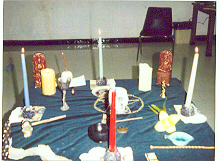
A Prison Beltane Altar

What is it like working with your “guys”?

They are funny, engaged, and interested. They are incredibly grateful for the time and interactions that any volunteers bring. Just to show up, look them in the eye and shake their hand and treat them like human beings. They don’t get that often enough except with the religious volunteers. I think that attitude sets the foundation for the engagement. We develop a give and take trust that makes education in this setting possible. The topics that we touch on are the difficult topics of life transformation. We don’t talk about their crimes, they all know that they are in their for a crime, we even joke about it. Once I mentioned, “Ya, well I get to go home after this”, and they replied, “Ya, they keep us here because we are criminals”. They know that they have made bad choices. In those moments when they are calm and grounded and connected, they want to be able to make better choices and know they don’t have the skills to do that. Continue reading

Local Celebration of International Pagan Coming Out Day

From a formal High Tea to a rally on the White House lawn, Pagans across the globe are celebrating Pagan Coming Out Day on May 2nd with local events and rituals.  The Twin Cities celebration includes cocktails, desserts, and the screening of American Mystic – a movie that the Wild Hunt called “the best documentary involving modern Pagans that this generation has seen.”

The event takes place May 2nd at the Sacred Paths Center and is open to all Pagans and Pagan allies, no matter if you have been ‘out’ for ages or are not yet able to be open about your Pagan spirituality.  It directly follows the usual Monday night Pagan Potluck and the event is offered as a free gift to the community.  An opening Hellenic-style libation to Hestia, a Goddess that strengthens the bonds of family and community,  kicks off the evening, with champagne cocktails, non-alcoholic drinks and desserts to follow.  Once everyone has their treats, the movie American Mystic will be screened for the first time in the Twin Cities area.  The documentary opened at Pantheacon to rave reviews. More about the movie below.

Pagan Coming Out Day Twin Cities
May 2nd – Sacred Paths Center
7pm to 9pm

Pagan Coming Out Day is an international movement created to be complimentary to Pagan Pride events. It’s a day when individuals, deciding on their own terms, stop actively hiding their religious identity to someone in their life. It’s also a day when our religious community comes together to support those coming out to a person or group and celebrates the more public emergence of their Pagan identity.   The not-for-profit organization behind Pagan Coming Out Day says they are “working to achieve greater acceptance and equity for Pagans at home, at work, and in every community.” To learn more about Pagan Coming Out Day you can go to their website or friend them on facebook.

Chuck, a Lakota sundancer in the badlands of South Dakota

Morpheus, a Pagan priestess in southern California

Kublai, a Spiritualist in upstate New York

AMERICAN MYSTIC is a documentary about three twenty-somethings, each a member of a fringe religious community, who have separated themselves from mainstream America in order to live immersed in their faiths. Kublai, a Spiritualist in the former revivalist district of upstate New York; Chuck, a Lakota sundancer in the badlands of South Dakota; and Morpheus, a Pagan priestess living off the grid in old mining country in southern California. Rather than an analytical, journalistic approach, AMERICAN MYSTIC takes a personal, visually lush approach, immersing the viewer in the subjects’ experience of their controversial faiths through their own words and worship.

Editor’s note:  Cara Schulz, editor at PNC-Minnesota, Chairs the Executive Committee of International Pagan Coming Out Day.  Jason Pitzl-Waters, Project Coordinator of PNC and author of the The Wild Hunt, also serves on the Executive Committee.
Pagans in Prison – Wiccan Minister in Minnesota

George A Edgar, Wiccan Minister and Pagan Prison Religious Volunteer at three Minnesota Correctional Institutions;  Stillwater, Faribault, and Shakopee

How are these decisions about religious civil rights for Pagans in prison made ?

The important decisions about what inmates can have or do in their religious practice are made by those that are least qualified and educated to do so. If you are pulled over for speeding it is the police officer who decides if you get a ticket, not a judge, a specialist in the law. If you say, ” I am on my way to minister to inmates”, they might just say, “Have a nice day”, and let you go. That has happened to me!  It is the same in the prison system, it is the guards and the chaplains who decide what goes on. When you get to the upper echelon, the Warden or the Department of Corrections, and they get excited, you tend to see draconian measures because they don’t want any headaches. They see things very practically, and the Pagans represent a slippery slope. They had to cave into the Native Americans. They allow outdoor ritual, the sweat lodge, the use of tobacco, now what if the Druids want that too? If you can get three or four guys together and a religious volunteer, you become a legitimate religious group. All of a sudden you may have thirty outdoor rituals a week, with special guards and space requirements. Where is the funding, where are the extra staff? They just don’t want the headache. They want to stop this as best they can.

Continue reading

Pagans in Prison – Religious Volunteer In Wisconsin

Wade Mueller is a religious volunteer for Pagans in seven Wisconsin Correctional Institutions. He is tired, but receives so much from his prison experience, and sees such a need, that he can’t stop if it means letting his people down.

 Do you actively advocate for an inmates religious rights or requests?

 I have to stay away from that as I have absolutely no power as a volunteer aid, and so am in a very precarious position. I tend to be polite and courteous in order to get entry and or anything at all with the inmates. Once inside I act as a priest, a facilitator, they cannot even get together as a group unless I come in. I tell the guys, “What do you want to do with this time?”. Some really want to do in-depth, hard-core rituals. Then I encourage and help them write their own rituals, and then just watch over and maybe help them. I may facilitate discussion, help with meditation. It is different every time depending on who shows up. There are so many different paths and traditions that show up, and there is often conflict.
Continue reading

Pagans in Prison – Interview with Patrick McCollum

This begins a series about Pagans in Prison, and those who ‘minister’ to them.  Religious volunteers report most Pagan prisoners find their Pagan path once they are incarcerated. The loss of freedom that prison represents is a strong motivator to find some meaning in life, and Pagan spirituality often offers the most relevant choice.  Prisoners are invisible to us, unless they get publicity.  I hope this series increases our  awareness of this part of our community for, sooner or later, many will return to our general society, and look for spiritual support.

Patrick McCollum

What is critical to understand within this topic, is the difference between loss of freedom, and loss of civil rights. Prisoners retain some civil rights even while in prison. Our Constitution’s First Amendment is about religious freedom, and within bounds, remains in force for those incarcerated.  I had the opportunity to interview one of the foremost authorities regarding religious civil rights and prison, and Patrick McCollum also happens to be a Pagan.  Read his qualifications at the end of this interview!

 There are prisoners convicted of state and federal crimes, often mixed together in state institutions, does it matter?

The principles are exactly the same in the law. In federal prisons there are some additional provisions that grant additional rights, more than state prison systems, but what I’ll talk about is applicable to both systems.

What are a prisoners civil rights regarding religion in prison?

There was a law upheld by the Supreme Court (unanimous) in 2005, called the Religious Land Use and Institutionalized Persons Act, (RLUIPA)  which laid out the basics of what religious accommodation prisoner of all faiths have right to. What the act says is that the state is required to accommodate each and every inmates religious need.

Continue reading