One of the Gateways to the Air Force for future officers is the United States Air Force Academy in Colorado Springs, Colorado. While earning their bachelor’s degree, military cadets participate in a rigorous athletic program and are instructed in how to lead others as an officer in the Air Force. In part 1 of our series, Pagans receive warm welcome at the ‘Gateways to the Air Force,’ we looked at Lackland AFB, where enlisted trainees attend Basic Military Training. In part 2, we take a closer look at the Air Force Academy (AFA) through interviews with Pagan faith group leaders, an Academy Chaplain, and a current Pagan Academy cadet.
When Pagans think about the AFA, what often comes to mind are the string of articles in 2007 showcasing the institution as the focal point for an evangelical Christian takeover of the military. It’s a view that appears to have come about due to an over-correction to the sexual assault cases that shocked the campus a few years earlier. Lt Col Dan Brantingham, AFA Cadet Wing Chaplain, explains, “In the aftermath of the sexual assault cases in 2004-5, some leaders looked to religion to assist cadets in living honorable lives. In doing so, the leaders unintentionally promoted a particular flavor of religion as the solution.”
The accounts of aggressive proselytizing of cadets by Evangelicals at the Academy worried civil rights activists as this influences the next crop of officers, planting the seeds to change the culture of the Air Force to a more repressive atmosphere.
Since 2007, the Academy has taken meaningful steps to renew its focus on freedom of religion and religious neutrality in its policies. Brantingham says he supports the current Academy policy of religious neutrality, “As an Air Force Chaplain my responsibility is to ensure the free exercise of religion for all cadets to include the minority faith group cadets. When I protect and advocate the freedom of religious conscience for all cadets, I fulfill my oath and because of the brilliance of the First Amendment, I safe-guard my own freedom of religion as well.”

“Four Freedoms” by Norman Rockwell hangs in Brantingham’s office with the quote,“Each according to the dictates of his own conscience.”
Cadet Nicole Johnson, a senior at the AFA, has experienced the willingness of AFA Chaplains to help cadets of any religion, “The Chaplains are wonderful. You can go to them with any problem. It can be just an every day problem or a spiritual problem and they are more than willing to help you out with it or connect you to the right people.”
Creating a culture of religious respect
How did the Academy change from being a perceived bastion of aggressive Evangelicalism to the open and inclusive institution Cadet Johnson is experiencing? A major step was taken when the Academy hosted the Conference on Religious Respect in 2008 and again in 2010. The conference examines how the Academy can create a climate of religious respect and equip its future officers with the skills needed to ensure religious beliefs are respected and accommodated. Out of the 2008 conference the Cadet Interfaith Council was formed, the Religious Respect Training program was launched, and support was increased for the Spiritual Programs in Religious Education (SPIRE).
SPIRE is time blocked off each Monday evening for cadets to meet and discuss spirituality. In addition to SPIRE time, Earth-Centered Spirituality cadets also celebrate the Sabbats, go on a Freshman retreat, and enjoy an annual Spring retreat.
The Cadet Interfaith Council meets once per semester and the faith of any requesting cadet is included. The Council assists the Chaplain Corps in monitoring the religious respect climate on the campus. Chaplain Brantingham says the Council, “has expressed frustration the press does not report on what they see and experience day in and day out, a climate of religious respect, and continues to unquestioningly keep slapping the Academy with the 2005 story-line.”
The third initiative to come out of the 2008 conference is what the Academy calls its “cornerstone religious diversity program,” the Religious Respect Training program for cadets, faculty and staff. The program is unique to the Air Force Academy as no other military academy or university has a program quite like it. It includes in-depth training on the First Amendment, and the Establishment, Free Exercise, and Free Speech clauses of the US Constitution. The program is modular and cadets have six hours of scenario and mission focused training on religious respect during their four years at the Academy. The Academy hopes this program assists future officers in creating a climate where airmen under their command feel free to request religious accommodation.
The Conference on Religious Respect in 2010 continued to examine and refine those initiatives. Sixteen national religious leaders were invited as panelists including Rev. David Oringderff, PhD, head of Sacred Well Congregation and sponsoring organization for the Earth-Centered Spirituality group at the Academy. In a message to the San Antonio Military Open Circle Yahoo group, Rev. Oringderff said he was impressed by the emphasis on ways to promote respect, not merely religious tolerance. He quoted Chaplain Brantingham’s remarks during the opening of the conference, “I don’t want to be tolerated; I want to be respected—and everyone else is entitled to that same right.”
Cadet Chapel Falcon Circle
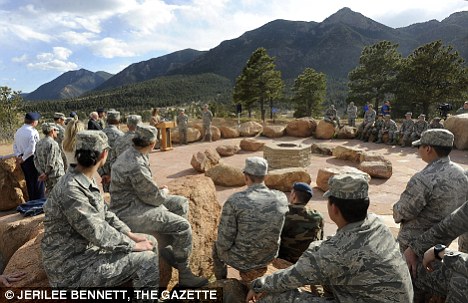
The most visible result of the renewed commitment to free exercise of religion is the creation of Cadet Chapel Falcon Circle. Falcon Circle, which sits on a hill, came into existence through the efforts of a former cadet wing chaplain, Chap. William Ziegler and former Earth-Centered Spirituality Distinctive Faith Group Leader (DFGL), Tech Sgt. Brandon Longcrier, who is currently deployed in Afghanistan.
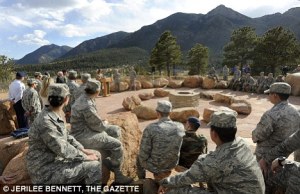
Cadet Chapel Falcon Circle at the Air Force Academy
In 2006 Tech Sgt. Longcrier and Reserve Major Kelly Ihme started a Wiccan circle at the Air Force Academy. They were able to instruct cadets because of two organizations – Sacred Well Congregation and the Air Force Academy’s SPIRE program. SPIRE was created in the early 1990’s to provide religious accommodation to faith groups not served by a chaplain of their faith. Longcrier contacted Sacred Well Congregation, which was already the Denominational Sponsor for other Pagan military faith groups, to sponsor him as a Distinctive Faith Group Leader (DFGL) for the Academy. Sacred Well Congregation agreed and the request was approved by the Command Chaplain at the AFA. Longcrier and Ihme could now form a faith group on campus.
The faith group went through a few name changes before they settled on Earth-Centered Spirituality. Originally called a Wiccan group, they later changed it to Pagan. Major Ihme, a mental health nurse and current DFGL at the Academy, says there’s a good reason for their present name, “[Earth-Centered Spirituality] is less threatening, especially to civilians living in the Colorado Springs area. We’re also want to be inclusive of Native American religions.” Nearby Ft. Carson has a sweat lodge and Ihme would like to cooperate with them, but they’re just beginning to explore the possibility.
The Earth-Centered Spirituality group met in an engineering classroom for worship before construction of Cadet Chapel Falcon Circle began in early 2010. The circle drew world wide notice when it was dedicated in Spring of this year. Some of the news articles and editorials were good, much of it was not. It also resulted in the resignation of Longcrier as DFGL at the Academy, “The Wing Chaplain and I had some very heated discussions about the name of the Circle. He kept wanting to call the Earth-Centered Circle a Chapel and also wanted anyone to be able to use it. To me, this was taking away something that belonged to us.”
Chaplain Brantingham says the decision on the name and the use of the circle was a joint decision between the Academy and Sacred Well Congregation, “I worked very closely with TSgt Longcrier’s national DFGL certifier at the time, Dr David L. Oringderff of Sacred Well Congregation. After extensive consultation with Dr Oringderff, TSgt Longcrier and Maj Kelly Ihme, USAF Reserves, I decided the best long-term solution for promoting religious respect and economy of resources was to dedicate the outdoor worship space as the Cadet Chapel Falcon Circle with the Circle being available to all cadet faith communities and the Earth-Centered Spirituality cadet community having scheduling priority. Dr Oringderff and the Academy’s current Earth-Center Spirituality DFGL, Maj Kelly Ihme, agreed.”
What brought matters to a head was the date of Falcon Circle’s dedication, “The straw that broke the camel’s back was when they set a date for the dedication of Cadet Chapel Falcon Circle on a date when I would be deployed. I put my blood, sweat, and tears into the program and getting the Circle approved and built and they thought that it would be ok to dedicate it without me being there? I resigned after that, but left the group in very good and capable hands.”
Longcrier also said he was concerned over incidents of religious harassment at Falcon Circle, “We already had incidents where Christians would go up there to pray for our sins and that isn’t what I wanted to be happening up at our sacred space.”
Ihme said that although there were early incidents at Falcon Circle, that is no longer the case, “At first there was some problems with Christians praying for our sins and some acts of vandalism [at the Circle] but no one besides us goes up there now. The site is very secure now with cameras running 24/7.” Ihme said the Circle is a peaceful place that seems far more remote than the short walk up the hill would indicate.
Rev. Oringderff had the opportunity to visit Falcon Circle while attending the 2010 Conference on Religious Respect, “The site is situated on the hill just above the Cadet Chapel and you immediately sense the spirit and sacredness of the place.”
Cadet Johnson describes Falcon Circle as a needed oasis of tranquility, “I go there during the day sometimes. It’s very stressful here so getting away from the academy is important. I can go and center myself and get more in touch with nature.” Johnson says in the four years she’s been at the Academy she’s never experienced a problem with religious discrimination or harassment.
Not every Pagan has a military career free of harassment, but many remark the military is generally ahead of the curve in accepting minority groups. Carlee, who left a comment on PNC-Minnesota’s article on Pagans at Lackland AFB, wrote, “Despite what people think, the military usually leads in the acceptance of minorities when the rest of the population still treats them as pariahs. Note the integration of blacks, the acceptance of women (I watched this one from 1979-1999 as more and more opportunities opened to me) and now the acceptance of gays. I am proud to have served in the nation’s military and to be one of the very few who has.”
Major Ihme wants Pagans considering applying to the Air Force Academy to feel reassured, “You don’t have to be nervous or afraid because every belief system is OK at the Academy. We will back you up.”
“You don’t have to be scared about sharing your religion or think you need to stay in the broom closet about it,” Cadet Johnson says. “People are very understanding. We have officers in charge of us who are very understanding, the Chaplains are very understanding so it’s very easy to be a Pagan at the Air Force Academy.”
Editor’s note: There was too much valuable and interesting material from interviews to include in this article. PNC-Minnesota will publish full interview transcripts next week.
 Very few modern Heathens can honestly claim they were born and raised in the religion. At some point, the majority of us made the conscious decision to become Heathen, even though we knew how we would be viewed by the general population. We didn’t care, we were following our hearts and doing what we knew was right. Most of us would do the same all over again.
 A Restorative Justice circle took place facilitated by
 Pagan Newswire Collective - Minnesota Bureau