Circle Sanctuary Minister joins Eagle Scout protest

Bob Paxton, a Circle Sanctuary Minister, has joined a growing protest by Eagle Scouts who oppose the Boy Scouts of America’s (BSA) policy that prohibit GLTB adult leaders.   On July 17, after a two-year review by an 11 person committee, the BSA reached a “unanimous consensus” recommending retaining the current policy of GLBT exclusion.  The Boy Scouts are a civil and spiritual organization aimed at building the character of youths age 11 – 17.  The rank of Eagle Scout is the highest rank attainable in the Boy Scouts and has been earned by less than 2 million young men since the program began in 1911 due to the commitment and difficulty involved.

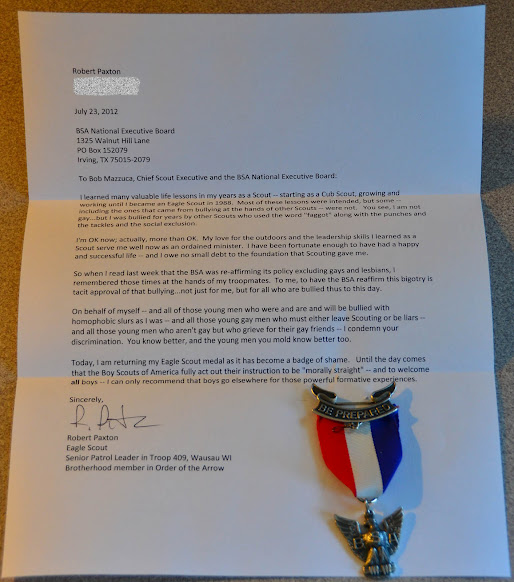
In response to the decision by the BSA to maintain its current policies regarding GLBT members, Rev. Paxton sent a letter to the BSA Executive Board asking them to reconsider the policy.  He also included his Eagle Scout medal, a move other Eagle Scouts are also taking.  The letter, in part, reads,

Today I am returning my Eagle Scout medal as it has become a badge of shame.  Until the day comes that the Boy Scouts of America fully act on their instruction to be “morally straight” – and to welcome all boys – I can only recommend that boys go elsewhere for those powerful formative experiences.

Quotes from the 11 minute interview:

“I can say that as a Pagan my experience as a Boy Scout directly lead to my choosing the Pagan spiritual path.  Experience that I had in the woods, experiences I had in summer camps, experiences I had in some of the ceremonial occasions very much led me in that direction.”

“As not only a minister but as a person who has a lot of gay friends and also who also received a lot of homophobic bullying at the hands of other folks in my troop I felt that by reinforcing on a national level the policy that gays, lesbians, transgender folks are not OK, are not acceptable within the Boy Scout approach that really they were ratifying that two level behavior that allowed a lot of that homophobic bullying that I and others in my troop experienced.”

“We are hoping to accomplish, not only by sending the letters but by publicly sending the letters a public shaming such that if nothing else it’s my hope that down in Irving, Texas as these letters and these medals come in with the mail delivery every day that somebody opens them up, puts them on a table, and takes a look at this and says, “You know, something’s wrong here. We have to do something else. People that we nurtured up to the verge of manhood are coming back to us now from 10, 20, 30, 50 years and saying no, you can’t be like this.”  If that doesn’t stand a chance of changing their hearts, I don’t know what will.”
A full transcript of the interview is forthcoming.

Yeshe Rabbit – Sacred Harvest Festival Guest – Interview

Lady Yeshe Rabbit
Sacred Harvest Festival Guest

I talked to Lady Yeshe Rabbit of the Come As You Are (CAYA) coven. We talked about her work in the San Francisco Bay area, her appearance at Sacred Harvest Festival, and her thoughts on gender issues in the Pagan community.

How do you like to be addressed?
For the most part you can call me Rabbit. My title in my coven is Yeshe, it is a word that has a few different meanings. In Tibetan it means “primordial wisdom”, and that is why I took the title, because I wanted to be guided by that primordial wisdom that resides within. It was also a childhood nickname, because I am Polish and my birth name is Jessica.

Tell me about CAYA?
CAYA coven is my coven.   There is within CAYA several different layers of membership. Some people have a casual relationship and may just attend our rituals. There is also an inner circle of trained clergy. These are people who have been with the group for a number of years. They would be my ‘closer’ coven you might say.

What is the role of CAYA in the Bay area?
CAYA stands for “Come As You Are”, and it is a coven that is built around the principles of eclecticism, inter-faith, and support for a wide variety of different paths. An individual who maybe has a very strong personal path, or, one who might be  just starting out and wants to learn about many different paths to see which one is the right fit, would find themselves very comfortable in CAYA. Each of us in CAYA feels that it is the utmost importance the we determine our own personal relationship with the divine. We then share our own individual practices and spiritual beliefs in the spirit of generosity without presuming that we know the one way that is right for everyone. What that means is that we are a coven “filled with solitaries” (jokingly), because everyone has their own individual practice. When we come together we join around a central core of protocols of how we do rituals in an outlined format, a baseline of ethics that we have all agreed to, and principles of community that we think are essential:  Cooperation, conflict resolution, clergy conduct and comportment. When people come into CAYA they feel very welcome, even if a beginner, or if they are extremely experienced and just don’t want to be told what to do because they are confident in their own path.

Continue reading

M.Macha NightMare – Interview

M. Macha NightMare

I was able to interview M. Macha NightMare as she waited for a plane to MSP airport, I asked her;

What have you been up to recently?

Well, Cherry Hill Seminary, which I am always working on. I hope will develop into a more stable foundation. It is something that needs more support from the Pagan community. They have wonderful teachers and students.

I have been working on a Pagan elders study. I did a survey on survey monkey, and got over 800 responses and have been analyzing that data. I have been starting to present on that topic. We have never had elders because we are a new religious movement. We are not a tribe in the conventional sense, and we really don’t have any role models. We have to look elsewhere for models. There are two different kinds of elders, one is older people, and another is people who have been in a community for a while and have some perspective and are turned to frequently for counsel or lore and things like that. Those are the ones I am thinking about. It is not defined and very haphazard. I think it behooves us to examine what our assumptions are about elders and try to put some things in place within our various communities.

What do elders actually do?

That is one of the things that I believe we as the Pagan movement have to determine for our communities. Who are the elders accountable or responsible to? What kind of matters do they address, if any? I got a lot of answers, but they are all over the place. Any human community has occasions and individuals that are not healthy for the well-being of the whole group, and may be dysfunctional and that may be unacknowledged. Some people see that behavior and may be frustrated or alienated. They may withdraw from a community instead of fixing it, or they may not know where to turn to get it addressed. I don’t have the answers. What I have is a lot of questions. It is not up to me to determine what the answers are. I can share some of the answers I got in the survey. I have my own ideas, but I don’t have a nice tidy description of what an elder is yet, because of all the input I have been given. It is pretty interesting. I come at this from a selfish perspective in that people have turned to me as an elder, and have not really known what my role is. I want to respond in an honorable way, or refer them if that seems appropriate.

Continue reading

Epilogue – After the interview, and PSG – Melissa Murry

After she returned home, Melissa sent me this statement, upon further experience and reflection:

Melissa Murry:

After the press event and while reading the response from the Pagan community at large who are affected by this, it remains clear that there is still confusion, pain, and healing that needs to be done. I am overwhelmed by the support of Ruth and myself. This shows to me that while we can come from different perspectives and beliefs there is a common ground. And while we don’t have to all agree with one another, that common ground can be a starting point for laying a foundation. That is what happened after this interview when Ruth and I spoke at length for hours. The conversation centered on misunderstanding, miscommunication, hurt, and healing around this event.

I finally began understanding where Ruth was coming from in regards to her perspective. I want to thank her for her time, voice, and passion. She told me that this was the first time a trans-woman had sat down with her and really talked to her about these issues in this way.

Continue reading

Two PSG Women Speak About Inclusiveness in Public Ritual – Interviews

I spoke with Melissa Murry late Friday afternoon at PSG, after her workshop presentation. This was her second year at the Pagan Spirit Gathering [PSG], her first year was a joyful experience.  She was concerned with the advance website ritual listing, though it was unclear then that it was a ‘main’ ritual. She expressed to Selena in advance of PSG that this was serious enough to consider canceling her registration.  Selena helped her schedule a late submission workshop on transgendered history in response.

*Note, from the PSG website:  [ A Dianic Women’s Ritual for Summer Solstice – Ruth Barrett

As a community of women who bleed, will bleed, or have bled our sacred bloods, we celebrate the Summer Solstice in a Dianic ritual that celebrates ourselves and honors the mythic cycle of the Goddess as She transitions from Maiden to fertile Mother/ Amazon/ Creatrix/ Manifester/ Maker. She uses her sacred uterine bloods to manifest tangible and intangible reality. We, in Her image celebrate our ability to heal, transform, and create our lives in this season of Her sacred fire. The ritual will also include a working around female reproductive rights. Think about in advance: As Creatrix in your own life, how do you use your sacred bloods? How do you feed and tend your creative fire? In honor of our sacred bloods and the summer solstice, please wear red as all or a part of your ritual garb. Bring drums and percussion toys if you have them. This ritual is for female born and raised women and girls. Facilitated by Ruth Barrett and women of the PSG community. ]

Melissa Murry at PSG Press Conference
photo: Bob Paxton / Circle Sanctuary

What led you to call Circle Sanctuary?
Melissa: I was concerned with the terminology used in the description of the Women’s Ritual as for women who  bleed, who have bled, or who will bleed. That is the definition that was used, but that does not define all cisgender women.  It is new definition that was created and used after Pantheacon to narrowly define the definition of women while the term “woman” is a broad term used in our culture to define self identified women. This is used to inadvertently define cisgender women, and it can be offensive because that use excludes trans-women who identify as women also.

Is it an unclear definition, what is there about it that causes concern?
The definition of that ritual was excluding women from PSG, but in the description for the ritual it was put forward as created and for all the women of PSG. I felt that there was an invisibility that was going to be created for transgendered women, like myself, who don’t fall within that definition.

So you objected to the limiting and exclusive definition of who the ritual was for, combined with the reference to the inclusive language describing a ‘community of women”.
Yes. I contacted Selena through the PSG website. Several people talked to me and eventually Selena called me, and we had over a four-hour conversation about the matter.  I can speak to what I took away from the conversation, but there was some confusion over the concern.  I understood the Pagan spirit Gathering was an inclusive event, and felt the exclusion of  a group of  women was not in line with the spirit of PSG.  Nor was it in accord with the values I believed Circle Sanctuary to have.

Continue reading