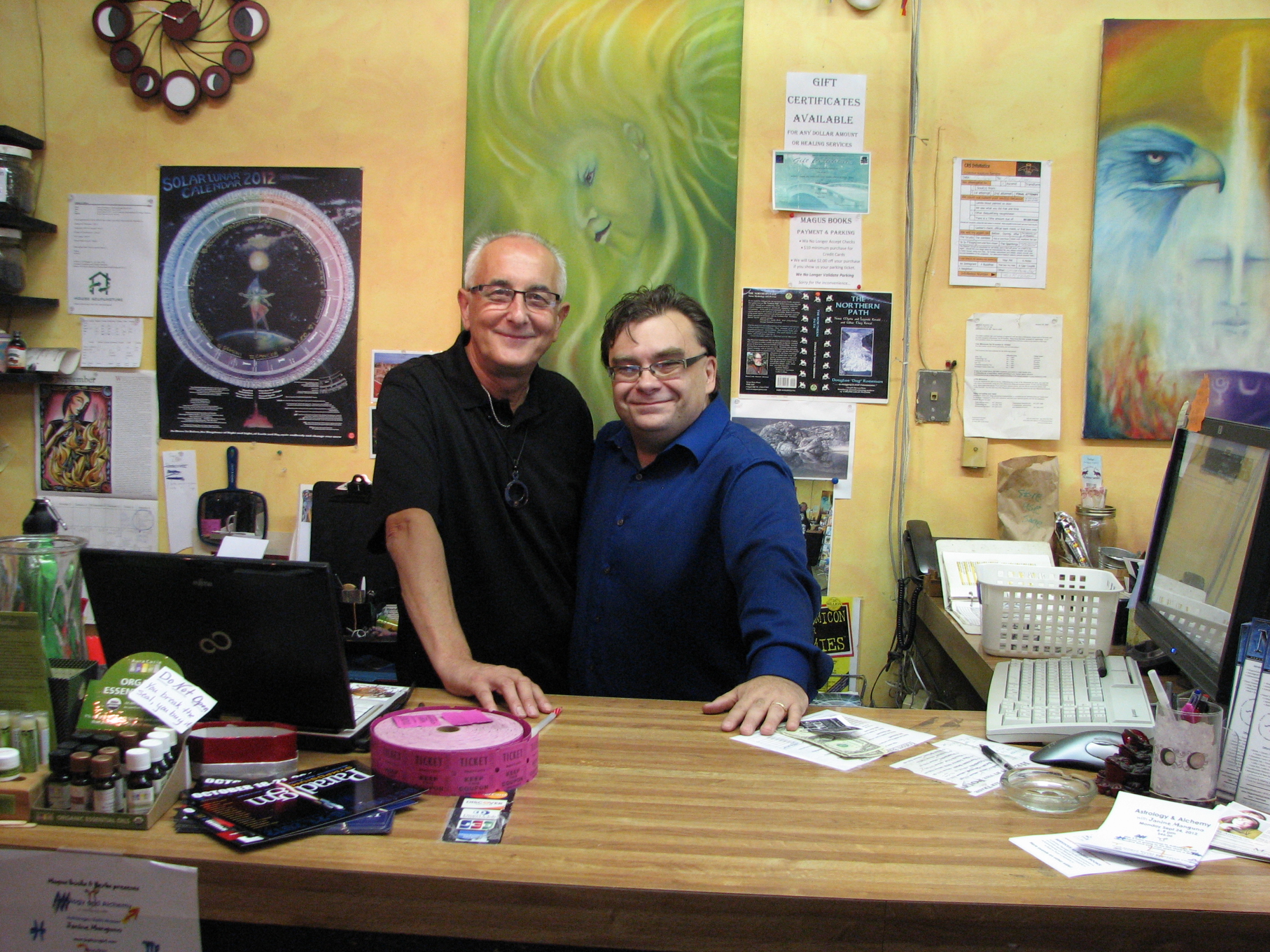
On Saturday, local metaphysical store Magus Books & Herbs, celebrated 20 years in business and owner Roger Williamson retired. Business partner Joseph Amara continues the Magus tradition and has plans for the next 20 years. PNC-Minnesota interviewed Williamson to learn about the store’s past and what the future holds for him.
Category: Happenings
Twin Cities Pagan Pride this Saturday, September 8th
Twin Cities Pagan Pride (TCPP) takes place this Saturday, September 8th, 2012 from 10am to 6pm. This is a free event, returning to Minnehaha Falls Park, in the area around the band shell. The 2012 TCPP event will again focus on public education in an outdoor site that has tons of public walk through traffic.
TCPP has a full schedule, with alternating music and ritual offered by local groups, individuals, and area talent. TC Reclaiming is offering a labyrinth walk all day. A community drum jam is scheduled for the last half hour, beginning at 5.30pm. New this year is a 15′ x 15′ tent central to the vendor area and adjacent to most of the organizational spaces that is being set aside specifically as a place to sit and have conversation.
TCPP encourages donations for their food shelf partner, charity donations, and for TCPP to support future events. volunteer help is always needed. Please stop by the information booth when you arrive and help out!
Ubaka Hill at Women’s Drum Center – Interview

Ubaka Hill
Ubaka Hill is appearing in Minnesota this week, sponsored by the W0men’s Drum Center.
CONCERT: Rhythms for the Trees: A Concert of Percussion, Poetry, Song and Vision
Featuring Ubaka Hill and with Drumheart. Open to the general public Saturday, August 25, 2012
Doors open at 6:00 p.m. for the Marketplace , Performance begins at 7:00 p.m.
Jeanne d’Arc Auditorium, Whitby Hall, St. Catherine University 2004 Randolph Ave., St.Paul, MN
Ubaka’s 2-day Workshop: Drumsong: the Art and Spirit of Drumming
(for women and girls)
Friday, August 24, 2012, 6:30-9:00 p.m. & Saturday, August 25, 9:30-1:30p.m.
At Carondolet Center, 1890 Randolph Ave., St.Paul
Register for workshop ($60) at www.brownpapertickets.com/event/258804
- Meet and Greet with Ubaka Hill, Tuesday, August 21st in Alexandria, MN
- Meet and Greet with Ubaka Hill, Wednesday, August 22nd in Two Harbors, MN
Ubaka arrived Monday to prepare for a week of appearances around Minnesota, we talked by phone.
What brings you to Minnesota?
The Women’s Drum Center ( WDC ) is responsible for brings me out and setting up the workshops and concert, and setting up the Million Women Drummers Gathering 2013 , what we call, “Meet and Greets”. One of those will include a workshop but these are primarily to speak about the Million Women Drummers Gathering 2013 initiative/movement and how local and global communities and individuals can be a part of it.
What is the Million Women Drummers Gathering 2013?
It is a two tiered, tow levels, and two phased program. There is a gathering planned for October 11-13th, 2013. Between now and that date it is about raising our consciousness, and becoming more awake and aware that our wooden musical instruments are trees. As simple as that is, it is quite profound to become aware that we are participating in the deforestation of our old growth forests, our third world local woods, and of our wooded areas within the US and around the world. I have been drumming on the wooden drum for over thirty years. There was a point where I was not as awake and aware, and mindful of my participation indirectly, by being a consumer of drums, in the deforestation and the senseless cutting and disrespect of the trees, and the woods. In the sustainability of our future. Around 2007, something awakened inside of me. That awakening had to do with our unconscious consumption of wooden instruments. I am including all wooden instruments, from acoustic guitars, to upright bass’s; pianos, marimba, clarinets, flutes, violins, cellos harps, all the instruments. If we do not sustain the trees that our wooden instruments are made from, we do not have a future for those instruments that we love to play, and listen to, that we enjoy dancing to. We won’t be able to sustain the music of those trees and so won’t be able to sustain the folkloric traditions of our various cultures. Generations that will follow us, will also not have the trees or the wooden instruments for those trees to play.
The Million Women Drummers Gathering 2013 initiative is essentially about creating a new mindful model as musicians and listeners, and players of wooden instruments. This call is coming from the leadership of women who love drums and who love trees. The Gathering in 2013 is a celebration of our new awake and aware selves, and our effort to create a new mindful model through planting trees, through having conversations about trees and creating a sustainable future, and to celebrate this by creating local rhythm circles including all players of wooden instruments while we plant trees and while we begin to create new technologies, ideas, and new approaches to a sustainable green policy for manufacturers, new traditions and new ways to approach the trees and the forest with gratitude and appreciation and the their replenishment.
Kirtan from the Heart – Gift to Sacred Harvest Festival
A Kirtan in Sanskrit means “praise, eulogy” . It originates in India and has spoken only forms and the more “liberal” Eastern Indian sung forms. It is a call response form of expression of devotion, and is at its essence a ritual to the Gods. It is from a world of 100’s of millions of Hindus and some forms of Buddhism, who celebrate their spirituality through the Kirtan. Alliances between these forms of spiritual Pagan expression are flourishing on the West Coast of the USA. Polytheists find more similarities in their worship than the vast cultural differences between Eastern practice and Western Pagans. Relatively new to Midwest Pagans, but becoming increasingly popular in “New Age” and Yoga based communities, the Kirtan movement is growing. Neo-Pagan connections to call and response, and voice based devotional ritual seems a logical extension in the range of Pagan practice.
Sacred Harvest Festival guest, Yeshe Rabbit, brought this workshop as a taste of this form of expression. The workshop guided participants through, “… a magical progression to align body, mind, and spirit.” I was drawn in and enthralled by the magic of this workshop. The power of Rabbit’s voice was inspiring to festivants as the sound drifted through the village. The workshop participants were ecstatic afterwards, and bliss enveloped the village for the week. Jai Maa! *
Gift yourself seven minutes, close your eyes and join in the song as you hear the culmination of what was over a 90 minute ritual Kirtan.
Listen to Kali Mata – Kirtan From The Heart
Jai Maa : This is a call to the Divine Mother, ‘Maa,’ a singing of Her glory. Literally, ‘jai’ means ‘victory,’ although we often translate it as ‘hallelujah’ or ‘praises.’ Speaking ‘Jai Maa’ in puja (worship ceremony) is an affirmation of the Divine Mother’s blessings, a chant of gratitude for all Her gifts and the challenges She provides that help us grow spiritually.
Andras Corban Arthen – Sacred Harvest Festival Guest – Interview
I can listen to Andras Corban Arthen all day. He has a rich, low voice with the gentle cadence of caring. He has a lifetime of experience in the Pagan community, and the depth of perception and the wisdom of his words keeps you riveted. He is presenting and performing all next week at Sacred Harvest Festival, near Geneva, Minnesota. Advance registration closes today, gate registration is available during the event Aug. 6-12th.

Andras Corban Arthen
You are just back from Europe, what were you doing there?
Andras: I go to Europe fairly often, since I have family and friends across the pond (I’m from Spain, originally), and a big part of my work is focused there. This trip served several purposes, the main one being related to a book I am writing, based on one of the presentations I will be doing at Sacred Harvest Festival (SHF) entitled The “Indians” of Old Europe. It looks at the cultures and spiritual practices that were originally called “Pagan” in the context of indigenous traditions from around the world. For over 35 years I’ve been searching for people in Europe who may be keeping alive the remnants of the old ethnic spiritual traditions of their countries, and have found some, both in Eastern and Western Europe, mostly in small, rural, out-of-the-way places where the old languages are still spoken. Most of them do not use the label “Pagan,” though their practices are not Christian and appear to be authentically very old. In some significant ways, they are quite different from what one typically finds in the modern pagan movement, and there are some important things that I think we could learn from them. When I first met these people I hadn’t been planning to publish a book, so before going further with this I needed to go back to touch base with them in person and ask for permission to write about them, their beliefs, and practices. I was able to do that with four of them, and in two of those cases wound up getting more information than I had before, so I’m pretty satisfied on that account.