Order of Bards, Ovates, and Druids East Coast Gathering 2012

This article is reprinted, with permission, by John Beckett.  The event was attended by several Midwest Druids, including the Crescent Birch Grove in southeast Michigan.

Now that I’ve told my big story I want to share my impressions of the rest of this year’s Order of Bards, Ovates, and Druids East Coast Gathering. This was the third year for this event and the second year for me attending.

The big difference this year was the size: 103 people were registered and I think actual attendance wasn’t much less. Word is getting around the OBOD community that this is a good event and the presence of two “Big Name Druids” was an added attraction. There were people from all over the East Coast (as far south as Florida), the Midwest, Louisiana, Texas, and California, plus one from the Netherlands. And of course, two from England.

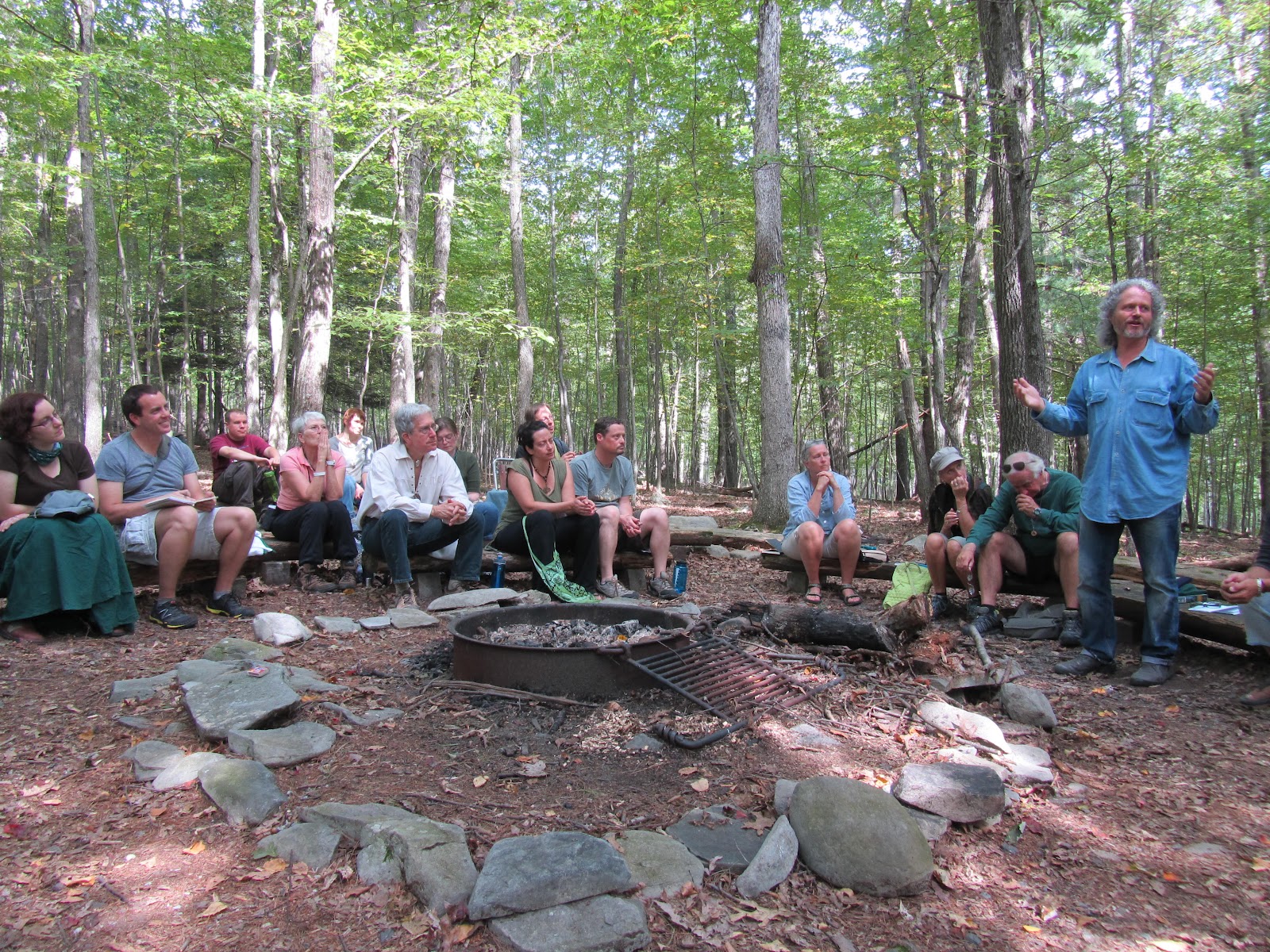
Philip Carr-Gomm gives the Chosen Chief’s address

Philip Carr-Gomm gave a Chosen Chief’s address that was more conversation than lecture. Many people expressed the intuition that “something big is coming” – being a UU Pagan as well as a Druid, I added “yes, and it’s our job to help create it!” Philip talked about the major crises of our world and how Druidry is a response many people are finding helpful. He also emphasized OBOD’s religious inclusiveness: there are Pagan Druids, Christian Druids, Buddhist Druids, atheist Druids, and the growing Spiritual But Not Religious Druids. I am undeniably a Pagan Druid and my primary interests are religious, but I agree we should keep our tent as big and as open as possible.

Editorial: Stop petting the dog

In my religion, Hellenismos, my ancient coreligionists used to practice expiation by scapegoating. Expiation is the act of atoning for wrongdoing so you are back in kharis (grace) with a divine being.  Think of it as a special type of purification.  How it combined with scapegoating is best seen at the Deipnon, Hekate’s Supper.  Once a lunar month, along with all the other observances, the household is purified with incense.  Sometimes, because of the immoral actions a family member committed, this isn’t enough.  In those cases the family would buy a dog.  The entire family would pet the dog which transferred their guilt onto the animal.  The dog was then killed and burned in sacrifice to Hekate.  Expiation.  Scapegoat (or scapedog)

Christianity has this concept central to their religion, but they most certainly didn’t come up with it.  Jesus was their scapegoat and method of expiation.  I’m sure many Pagans, Heathens, and polytheists reading this are as horrified about what the Greek polytheists did all those hundreds of years ago as they are repelled by Christians bathing in Jesus’ blood today.  Yet we Pagans do it all the time in our communities.

We get our tail caught in the wringer and instead of focusing on making the situation better, we place all our embarrassment and anger on the person who pointed it out.  “They’re trying to destroy us,” or my personal favorite, “They’re making us look bad.”  We, none too gently, pet them over and over hoping we can rub our mistakes off onto them.  We encourage others to do the same.  And then we try to kill them in some way.  Make them go away, get them out of our site.  We want them to sink under the burden of our misdirected shame and disappear.

We do it.  You’ve all seen it and can point to examples large and small, public and private.

The roommate who is treated poorly and later kicked out because he won’t overlook the growing chemical addiction and mental health issues of one of his fellow roomies.  They know there’s a problem and they feel guilty and scared and ashamed for not facing it.  So they turn all that into anger and they heap it onto the one willing to speak up.  They pet the dog and then kill it.

The community member who notices a problem with an organization or a group.  Suddenly she is the bad person trying to tear down community.  Why can’t she just shut up?  It must be because she has evil motivations.  We have to isolate her, trash her and try to ruin her reputation.  She is bad and if she would just go away, everything would be fine again.  The problem wasn’t anything to do with us, it was her.  Pet the dog and kill it.

We do this instead of having a difficult conversation with our roommate about getting help and staying on prescribed medication.  We do this instead of making uncomfortable changes within our groups to make them better and stronger.  We would rather harm someone else than acknowledge our own failures.  This hurts us.  When we do this, we are the ones destroying our community.  We are the ones with bad and self motivations.  We are the problem, not the person we wounded and drove away.

We need to stop petting, and then killing, the dog.

Editor’s note:  We have not published several comments from people across the country assuming this editorial was written about a specific person or situation in their community.  This shows the universal and pervasive nature of scapegoating with expiation in Pagan, Heathen, and polytheistic communities across the country. 
Restorative Justice II at Sacred Harvest Festival – Editorial

Thursday, August 9th, the second community Restorative Justice (RJ)  circle was held at Sacred Harvest Festival,  a year after the first. The festival was a lot different place this year, it was observable that an immense amount of grief resolution and healing had taken place over a year. A focus on the festival theme of the sacred in our lives, and the power of love, had seemed to replace a sense of anxiety, hurt, grief, and fear that many had felt a year ago.

The Circle was much smaller this year, down to 15 participants, with 6 having their first experience with RJ at this circle. The feelings of the nine who returned were softened,  and reflected a feeling of a return to normalcy, which in this case is defined by the tribal sense of family this festival has generated based on the feedback of thousands of individuals over fifteen years.

Crystal Blanton had offered to facilitate this RJ circle again.  Crystal began with establishing a talking stick. This year she used a personal Phoenix tradition piece because:

“What we are doing in this community. We are rising from circumstances, regardless of what those circumstances have been, and where everybody falls in that. Taking where we are at, and using it as a catalyst to grow into something beautiful and bigger, and in some ways unimaginable.”

Crystal solicited;  “Any questions before we begin?   None were asked.

Crystal Blanton

Crystal:

“We open with two pieces to set the tone for where we have been, and where we are going :”

“The most precious gift we can offer others is our presence, when mindfulness embraces those we love they will bloom like flowers. “

And from an article: “Contact beyond the Gods”

Crystal read a quote about the spiritual importance of connection, and the connection we all have with each other. Acknowledging the importance of the process we are in, how we integrate the lessons we have learned into our spiritual being, and into the path before us. Not only learning how to work in community, but teaching how to work in community, for our children. Preserving what we have worked so hard for here.

Crystal begins the RJ circle offering two values she brings, asking each participant to state a value they bring to the circle.

Continue reading

Andras Corban Arthen – Sacred Harvest Festival Guest – Interview

I can listen to Andras Corban Arthen all day. He has a rich, low voice with the gentle cadence of caring. He has a lifetime of experience in the Pagan community, and the depth of perception and the wisdom of his words keeps you riveted.  He is presenting and performing all next week at Sacred Harvest Festival, near Geneva, Minnesota.  Advance registration closes today, gate registration is available during the event Aug. 6-12th.

Andras Corban Arthen

You are just back from Europe, what were you doing there?

Andras: I go to Europe fairly often, since I have family and friends across the pond (I’m from Spain, originally), and a big part of my work is focused there. This trip served several purposes, the main one being related to a book I am writing, based on one of the presentations I will be doing at Sacred Harvest Festival (SHF) entitled The “Indians” of Old Europe. It looks at the cultures and spiritual practices that were originally called “Pagan” in the context of indigenous traditions from around the world. For over 35 years I’ve been searching for people in Europe who may be keeping alive the remnants of the old ethnic spiritual traditions of their countries, and have found some, both in Eastern and Western Europe, mostly in small, rural, out-of-the-way places where the old languages are still spoken. Most of them do not use the label “Pagan,” though their practices are not Christian and appear to be authentically very old. In some significant ways, they are quite different from what one typically finds in the modern pagan movement, and there are some important things that I think we could learn from them. When I first met these people I hadn’t been planning to publish a book, so before going further with this I needed to go back to touch base with them in person and ask for permission to write about them, their beliefs, and practices. I was able to do that with four of them, and in two of those cases wound up getting more information than I had before, so I’m pretty satisfied on that account.

Continue reading

Happy Birthday PNC-MN! Two Years of Reporting

The Pagan Newswire Collective – Minnesota Bureau is two years old!  The Minnesota bureau first posted Community Notes from TCPagans on July 28th, 2010.

So how have we done?

Here are some of the stats for our first two years. We have had over a quarter million page views, averaging 250/day or 4000 -10,000 a month. Twelve of the last 24 months averaged over 7000 readers. On our best day we had over 28,000 readers stop by. We have written 488 posts, an amazing number in two years! We have tripled direct subscribers to 223, added 1800 twitter subscribers and another 750 who follow our Facebook page for posting notices. All of our posts get a fair reading, especially over time. We learned the power of Facebook when one of our top posts went viral on Facebook and we had over 45,000 visits in just a few days. I have to credit Cara for covering many of those stories which skew our stats upward. She has a long background in finding compelling stories that interest Pagans! As the editorial editor, I am really satisfied that over 25 of our editorial articles and interviews have over 500 views. Our content is used as a resource for other news and religious writers across the internet.

Continue reading