Who’s at the door? Ex-Offenders – Interview

In the next few years many Pagan groups and communities will be confronting how we receive released and reformed prisoners.  How Pagans answer this question will in part define who we are, an important question.

At Paganicon this year,  Morninghawk Apollo is offering a workshop/discussion on the topic.  He describes it as:  “Many new members coming to the Pagan community are former prison inmates who became Pagans while locked up.  At many institutions, either Wicca or Asatru is the largest religious group, not counting solitary practitioners.  The vast majority of these inmates will be released at the end of their sentences and wish to join the Pagan community.  Statistically, if your group hasn’t been approached by an ex-con yet, it will be. Have you considered your response? What reception should we give these Pagans when they are released? Bring your thoughts, fears, and ideas for a lively discussion of this important topic. “

Photo: workinglinks.co.uk

Morninghawk has been offering prison ministry with his wife since 2004.  He took a three-year break in the middle, and is back serving two Moose Lake, MN facilities.  The Minnesota State Correctional Facility (MCF Moose Lake) is a regular prison and has inmates, called “offenders,” who wear uniform clothing.  The Minnesota Sex Offender Program (MSOP) is a post-sentence medical treatment facility that houses inmates, called “clients,” who wear whatever they want within reason.  Many inmates convicted of certain sexual offenses are civilly committed by the court to the MSOP program after completing their MCF prison sentence.  Both are secure facilities, and look like prisons when you drive up.

I talked to Morninghawk about his work:

What are the facilities you minister to?
Morninghawk:  At the MCF is a level three medium security facility, meaning many have served their “hard time” at a facility like Stillwater or Oak Park Heights.   They are generally on their way to release in the next five years.  At MSOP, there is no defined release time.  If they graduate from this program, they are transferred to the MSOP program in St.Peter, MN.  If they graduate from that program they may be released to society from there.   In the seventeen years the program has been running, only one client has been released from St. Peter,  just this past year.  Both facilities are all men.
Continue reading

Am I a Pagan? – Editorial

Photo: kitchenwiccan.com

Quite a few people anguish over their personal answer to this question.   We should all know what to say, but usually stammer around a little and say something vague.  There is a discussion among Pagan intellectuals about whether your beliefs and practices can safely fall under the broad definition this term offers.  The modern definition of Pagan arose with a pretty Wicca-centric focus, so the further your practices and beliefs get from that, the less safe this umbrella term may feel.  Can we agree to a term or definition that works better in the future?   I don’t know.  Nearly everyone has a different answer, when asked, “So what is a Pagan?”   I see the value for those who embrace the word in finding a good definition for the term we can all use.  A definition that is accurate and inclusive, and doesn’t offend anyone.  I will leave that to others to technically work out, it doesn’t interest me that much.  I just like the term Pagan.

I grew up in the 60’s and 70’s when the word “Hippie” was kind of similar.  For some it conjured up dirty, disheveled, long-haired lazy people, self-absorbed in mind expanding drugs and having loose moral standards. I never minded when someone called me one as hate speech.  I knew they meant one thing, but it meant something else to me.  I embraced the label for its vision.  I saw it as representing a new way of looking at life, as re-assessing of what was important, and letting go of the expectations of others and our society.  I liked the “Peace and Love” platform.  I soon learned in personal application it often meant “my” peace, and “my” love, as  interpreted at any moment. The Hippie movement quickly degenerated, maybe because it didn’t have a clearly articulated definition that guided and sustained people who claimed the term.

Continue reading

Crossed Quarters – Guest Editorial by Lisa Spiral

Most Pagans are aware that the eight sabbats of Wicca are an artificial construction. They combine festivals of hunter/gatherer peoples with festivals of agriculture and animal husbandry. When you add to that an international following and crazy modern scheduling you have a practice of worship that is truly Neo-Pagan.

Our quarter celebrations, the solstices and equinoxes, come to us from people’s who understood astronomy. These are real and measurable events in time and space. The tools and precision of measuring when these sabbats occur have changed over time. The events that they celebrate are fixed.

The cross quarters, however, are seasonal celebrations. They mark events of weather and harvest that happen when they happen in the local area. We know from the names we call them by: Imbolc, Beltane, Lughnasad, and Samhein that these are sabbats from more northern climates. These are celebrations of a people who were dependent on an unpredictable weather.

They may have marked migration cycles. They may have marked the end of a harvest season. They may have marked blooming plants. They may have marked fertility of farm animals. But these kind of events occur at different times in different places in different years.

Our calendars come to us from the Romans and the Roman Catholic Church. When these local festivals were assigned patron saints and attributed to saints days on the calendar they became more fixed in time. Of course the church calendar has changed once or twice over the last several thousand years and saints come and go. Continue reading

In Syria and Egypt, Pagan voices fall silent

Areas where there is political turmoil or fighting are often difficult places for even those in the mainstream of a culture to live in.  It’s even harder for people on the fringe of society as they face confusion, uncertainty, deteriorating living conditions, and daily fear for personal safety.  Those set apart by ethnicity, language, sexual orientation, political views, or religion are the most vulnerable to loss of property or even loss of life.  In Syria and Egypt, two countries currently experiencing political turmoil or civil war, one by one Pagan voices have fallen silent.

There are eight Pagans, three in Egypt and five in Syria, that I have regular contact with online.  They had always been cautious about revealing their religion to people within their country and expressed dismay over their isolation, but they were happy to talk online and wanted to know what American Pagans, especially those who practice Mesopotamian or Kemetic religions, were doing.

Egypt
The Egyptian Pagans, who were elated at the fall of Muburak, expressed hope that a truly democratic government would emerge in Egypt.  Then,  concerns crept in at the increasing power of the Muslim Brotherhood.  Karim saw the Brotherhood as a threat to both his country and to him, as a Pagan, personally.  Over the past seven months, the lag in communication grew as he became more politically involved and went to rallies and protests.  He expressed fear that pagans and other religious minorities were in increasing danger and that the Christians would sacrifice people like him to the Brotherhood to appease them.  The other two Pagans I communicate with followed a similar pattern.  Elation, followed by concern, followed by fear and determination.  Then silence.  I have no way of finding out if they are simply too involved with the political turmoil in Egypt to respond, if they are keeping quiet to avoid suspicion, or anything else.  It’s been three months since I have heard from any of them.

.
Syria
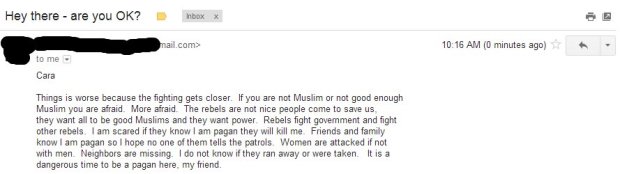
The situation in Syria appears to be more grave, according to the last messages I received from the five Pagans I chat with regularly.  They spoke of the fighting and how places looked like Beirut,  buildings just shells of themselves, rubble blocking the streets.  They detailed neighbors going missing.  Islamic fundamentalist patrols that monitor behavior and took violent action against people who violated rules and customs. They debated fleeing, worried about being outed as a Pagan, and started destroying or burying altars.  Three began attending local mosques to show their devotion to Islam.
email for article

Last email received from Yana.

Yana dropped off first.  I last heard from her in June of 2012.  Bayan, another Syrian Pagan, also hadn’t heard from her but said fighting in her area was intense.  He said he had seen patrols targeting young women and men, beating them and he said it was rumored they were raping them.  He thought perhaps she fled to a safer area or was silent to avoid detection.

That was the last email I received from Bayan.  Like dominoes the other Syrian Pagans went silent.  No emails or texts.  No word on their safety.  I keep hoping I will hear something, but it’s been several months and still no word.

I reached out to a Pagan in Lebanon, Adon, to see what he has heard about his coreligionists in Syria and Egypt.  Although he’s not in the same country, he’s much closer than I am.  I asked Adon if he had heard from Pagans in Egypt and Syria.

I haven’t heard of my pagan friends in Syria for a while too now, i know at least three of them who moved to other countries, especially Algeria, and United Arab emirates, but i have lost their contact in the process. The others are still silent, so they’re either disconnected, moved from the country, or worse. It’s hard to tell at the moment, pagans in the Near East were already several secluded clusters of individuals who don’t have a lot of contact with each other before everything started to happen. This is the case even in Lebanon where it’s relatively easier to be open about one’s religious identity.

I didn’t had any contact previously with Egyptian pagans, but they’re probably fine, but everyone in Egypt is too distracted to think about anything but politics and survival at the moment, i’ve had trouble having a decent conversation even with non-pagan egyptian friends in the past few months.

Anyway, you’re right that the atmosphere is getting a lot less safer for non-muslims in general and even for less devoted muslims. It’s very risky to even discuss religion in Syria at the moment, whether we were in the areas controlled by the regime or by the rebels. In Egypt the situation is a bit brighter since there’s a larger civil society and minorities in general and things are still relatively peaceful. However, the general feeling here is that this is temporary, the Islamists are taking the lead now after being in the shadows for decades, and all this will catalyze the process of getting over fundamental Islamism faster.  – Adon

My hope is that peace and liberty come to this region of the world.  I hope my friends are safe and that someday soon, they can live without fear.  That their voices are once again heard and this terrible silence ends.  May Anu and Horus watch over them.

Gifts and Thank You’s – Editorial

Photo: vec.ca

Gifts, they are on most of our minds this time of year.  We anguish over giving them and receiving them, who needs one, who might give us one, why we give them.  It is residue from that dominant holiday in our culture, at least the anguish is.  Most of the gifts we really appreciate are the ones given from the heart, and specific to ourselves and the receiver.  There is a strong alternative movement against all the commercialism.  Give some cookies, or a hand-made necklace, a poem, hand-made card, or a special artifact of nature.  Give something really personal, these things often have more meaning.

Thank you.  Our thank you conversations are the flip side of gifts.  We always say thank you, but we can’t help but betray what we feel most often.  The enlightened honor that old saying, “It’s the thought that counts.” and really endeavor to feel it.  It doesn’t matter if we already have two, or don’t need want or like it.  It may even feel like an obligation or burden.  Why did we not think of them and have a gift?  Whatever we feel, as we accept it, we also know most times the giver instinctively senses our reaction, and it falls into a couple of categories.  We loved it and appreciate it, we are ambivalent and it is a little awkward, or they sense our subtle dread at the responsibility of accepting it.  However it takes place, we complete the gift-thank you ritual and keep moving, it is that busy time of year.

Twin Cities Pagans

How can we avoid the stress of this time of gifts and thank you’s?   What got me thinking about this was the ending of the Paganistan weekly. What a gift.  JRob took the task of building a network of people, and a place to share personal and community events, applied his love and vision of a better community, and just ran with it.  The list, Twin Cities Pagans had been around since year 2000.  I found the post when JRob got involved , message # 649, Aug 18th, 2008:

Blessings All,
I couldn’t find a place which listed the area Pagan events in one calendar, so I asked Robin and he said I could use the calendar from this group to keep track of events.  So if you want to keep up on local Pagan events, check this group’s calendar.  I’m on a bunch of local groups and I continually add things as I find them.
Oh, and I also updated the links section. But I’m not calling dibs.  I hope that other people also feel free to add things.

Many Blessings, Jrob

Continue reading