Editorial: Tilting at Wikimills

I’ve been engaging in something that may be an exercise in futility, working to improve (read: keep from being deleted) an article on Paganistan on Wikipedia. The article has been tagged for deletion for not being note worthy enough.  Not enough sources they consider ‘reliable’ have written about Paganistan, which is short hand for saying the mainstream press hasn’t written much about us and the other sources listed aren’t reliable for one reason or another.   From the discussion on the Article For Deletion page, it’s looking like this article, as the one on Sacred Paths Center which was already deleted, is on the fast track to non-existence.

So why have I been tilting at this particular windmill?  Because too many articles on Paganism are being deleted on Wikipedia.  Because this action on Wikipedia highlights the difficulties Pagans face gaining acceptance and inclusion in mainstream society and how the rules are discriminatory in practice, if not in intention.  Because Wikipedia matters and is used as an initial stop for information gathering for the Average Joe and for media, like it or not.  Most of all, because Pagans and Paganism are noteworthy.

Continue reading

Pagans in Prison – Editorial

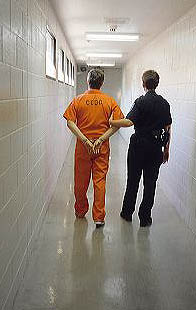
Click for large image!

We have had an explosion of incarceration in the United States in the last 30 years.  Minority races, the poor, and least educated continue to be way over represented as inmates statistically. Addiction, and our society’s inability to cope with the plague it represents, contributes to arrests and recidivism, and drug offenses fuel incarceration rates. Young males dominate the populations of our prisons, while female rates explode proportionately but in smaller overall numbers. One in 28 US kids has a parent in prison, and that tells much of the story of where the males are that might be a role model.

The religious civil rights of Pagans, or any inmate, are now well established in law. Whether the implementation of that law takes place seems to depend on individual states, institutions, and the staff and chaplains who work within them. Officials and inmates can work together to find reasonable accommodation to individual spiritual practice, and equity of accommodation among the many spiritual paths in prison, or we can all bear the cost of resolving these issues through the courts.

Inmates pay for their crimes through the loss of their freedom. To expect them to lose the rights our Constitution considers basic human rights is more for our satisfaction and as ‘punishment’ for those who may have caused us pain or harm.

Continue reading

Pagans in Prison – Inmates Comment

The inmates at various Department of Correction Facilities have been tracking this discussion of Pagans in Prison, and are aware of the civil rights issue in Stillwater Prison.  Nearly all Pagans in prison find that path in prison. They have no history with a ‘Pagan community’. They have the idea that we as Pagans have a spiritual community like many Christian groups do. Inmates, therefore, tend to have a real idealized vision of our ‘Pagan community’. We are presumed to have facilities, programs, ministers, outreach programs, and the dedication to help our ‘brethren’ in need, and they know they certainly need help. Maybe they suffer from the same attitude we hold, we want a lot from our community and don’t have the time or resources to put a lot into it.


Many of the facilities have functions, and  Faribault is considered an ‘exit’ facility. It houses over 2200 mainly low risk inmates, double bunked, with mainly shorter terms. They are preparing to leave incarceration in a few months to a few years, and will be approaching our community as they seek their Pagan paths.


What do you want from the Pagan community as Pagans in Prison?

 We want to be able to learn more, and to be able to meet people in a positive fashion. We want to start building  some positive relationships now, that will be available to us once we get on the outside. Ninety percent of us are here because of the people we hung around with. When we get out, if we hang with the same people, we will be back in here. We need Pagan people to hang with! Continue reading

Pagans in Prison – Women Ministers in Prisons

Emrys Anu is a Wiccan Minister volunteering for the last six years at Rush City Correctional Facility.  She has volunteered in the past at Red Wing (18 months) and Stillwater Correctional Facility (2 yrs.).

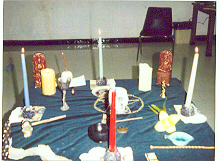
A Prison Beltane Altar

What is it like working with your “guys”?

They are funny, engaged, and interested. They are incredibly grateful for the time and interactions that any volunteers bring. Just to show up, look them in the eye and shake their hand and treat them like human beings. They don’t get that often enough except with the religious volunteers. I think that attitude sets the foundation for the engagement. We develop a give and take trust that makes education in this setting possible. The topics that we touch on are the difficult topics of life transformation. We don’t talk about their crimes, they all know that they are in their for a crime, we even joke about it. Once I mentioned, “Ya, well I get to go home after this”, and they replied, “Ya, they keep us here because we are criminals”. They know that they have made bad choices. In those moments when they are calm and grounded and connected, they want to be able to make better choices and know they don’t have the skills to do that. Continue reading

Pagans in Prison – Wiccan Minister in Minnesota

George A Edgar, Wiccan Minister and Pagan Prison Religious Volunteer at three Minnesota Correctional Institutions;  Stillwater, Faribault, and Shakopee

How are these decisions about religious civil rights for Pagans in prison made ?

The important decisions about what inmates can have or do in their religious practice are made by those that are least qualified and educated to do so. If you are pulled over for speeding it is the police officer who decides if you get a ticket, not a judge, a specialist in the law. If you say, ” I am on my way to minister to inmates”, they might just say, “Have a nice day”, and let you go. That has happened to me!  It is the same in the prison system, it is the guards and the chaplains who decide what goes on. When you get to the upper echelon, the Warden or the Department of Corrections, and they get excited, you tend to see draconian measures because they don’t want any headaches. They see things very practically, and the Pagans represent a slippery slope. They had to cave into the Native Americans. They allow outdoor ritual, the sweat lodge, the use of tobacco, now what if the Druids want that too? If you can get three or four guys together and a religious volunteer, you become a legitimate religious group. All of a sudden you may have thirty outdoor rituals a week, with special guards and space requirements. Where is the funding, where are the extra staff? They just don’t want the headache. They want to stop this as best they can.

Continue reading