Deborah Lipp at Paganicon – Interview

Paganicon 4 begins this Friday

Deborah Lipp

Deborah Lipp

March 14th  7pm – 16th 4pm

at the Doubletree Park Place

St. Louis Park , MN

Deborah Lipp and Oberon Zell-Ravenheart are Guests of Honor

I got the chance to interview Deborah Lipp about her appearance beginning Friday at Paganicon

You will be sharing the opening remarks for Paganicon with Oberon?
Yes, we have known each other for many years. We discussed the talk and were on the same page so we decided to work together on the keynote address. The talk will be about our Pagan history, its importance, and how to preserve it, and to know who we are, and then lead into some ideas about the future.  I published a memoir about a year ago, and now Oberon has one that has just come out. I was particularly affected by the death of my ex-husband (Isaac Bonewits), and felt very strongly the importance of history, of knowing who we are and who we came from.

You also have a long time history of participating in the Pagan festival movement?
I have been a festival participant quite literally from the beginning. I went to my first festival, well, right before I was initiated at age 21. Before my son was born, I went to 3-4 Pagan festivals a year. After his birth it was more difficult and I have slowed down, but I have been going to festivals for more than 30 years. Festivals were something that my high priestess, as a young witch, was very adamant about. Going to festivals was a way of meeting people, of exchanging ideas, of learning cool new chants to use in ritual. It was important. This is a part of Pagan history, too. As a young Pagan entering the community and you may not value festivals because they are corny, people dress funny, and you have to sleep in a tent. They don’t understand that the existence of the festival movement, which began in the eighties and didn’t really take off for another five years, transformed the face of the Pagan community. It is one of the most significant contributions to the Pagan community of the last thirty years. Before there was an internet, there was a Pagan festival movement.

Has the role of festivals changed over the years?
Electronic socializing has become really important. The fact that there are now so many ways to communicate as Pagans has diminished some of the importance of the festival movement. Now ten years after the rise of festivals we have what I would call the solitary movement. Prior to the publication of “Wicca: A Guide for the Solitary Practitioner”, people were not solitary by choice. People were solitary because they could not find other people to work with, period. A solitary was a person who had not yet found a group. The idea that you can be solitary because you want to be was facilitated by the festival movement because you can be solitary and at festival still share ritual with others. There you have a community that you can connect with. People make fun of it, you know, Beltain and Samhain Pagans, party Pagans, and such. The fact is coven work is not for everyone. The festival movement provided a source of different models for how to be Pagan. Maybe you have a 11 months  private solitary practice and then one month at festival and spend time connecting with your community. For those of us who came up through a coven system, festivals were our first insight into other ways to express Paganism, and how to relate to our community.

What about the beginnings of indoor Pagan conferences?
They have been around our community just as long as any festival. The first indoor festival was Gnosticon. The convention style event has always been a part of the mix. Every festival type event will have its own particular flavor. Some are intellectual, or ritual “heavy hitters”. Other may have a music or arts focus, or be more “party” oriented. Some festivals are more geek oriented and have a relationship to that culture in their personality. I have been to festivals all over the world, from Australia to Canada to Brazil. The people pretty much all look alike, they all look like Pagans. You feel at home and a sense of community, but the style and personality will vary.

What will the “Way of Four” workshop at Paganicon cover?
This will be drawn from my book, The Way of Four, about the four elements.  The workshop will cover, “What are the four elements. What parts of life do they apply to? How do they affect you? How do you work with them? How do you use an understanding of the four elements to enhance your quality of life?” The attendees will help guide the direction that we go in during the workshop. It is sometimes very interpersonal and questions about elemental issues and ideas may direct the focus of the workshop. First and foremost it is about a basic understanding of the four elements. The four elements are the building blocks of all occultism. I am passionate about that. You cannot read the Tarot, do high magic, or use astrology without understanding the four elements. They affect not just Wicca or magic, but nearly everything in the occult. We will come away with a deep set of correspondences with the four elements and then learn to apply them to different situations. This is one of my favorite workshops.

You wrote two books on the Way of Four, though.
When I wrote The Way of Four, I was trying to be very complete. Write down everything about the four elements, four elements in meditation, in nature, in your love life, in your home, in work. This how I write. As I was doing this I eventually got to “spells” of the four elements. As I worked I several times said, “You know I could write a whole book about this.” Out of this came the book “The Way of Four Spellbook” which is specifically about spells and magic. It is really a “how to” instructional book rather than a recipe book, each spell serves as an example of the lesson just discussed in the book. A sex magic spell would fall under the element of fire type of spell. We can just mention that in the interview because then everyone will perk up and listen and want to attend the workshop!

The “Heroes Journey” workshop centers around the Rocky Horror Picture Show. Are you a fan?
Yes I actually performed in it at the Eighth Street Playhouse in New York City, back in the day. It was a floor show or, as it now called, a “shadow cast”. You perform the movie live while the movie is going on. I am very interested in pop culture as a modern mythology and a modern form of religious expression. Rocky Horror, with its passionate cult following, is the perfect event to have this discussion around.

What do bring to Paganicon that will attract us?
First, I talk a good game, I hope you have noticed this! I am very entertaining, part Wicca, part stand up comedy. People do appreciate that because most writers are introverts. I am very extroverted, very talkative, and that is fun to experience. You get the kind of knowledge you expect from someone who has written six books but I’m also someone who is used to being interactive and thinking on my feet. Many writers can’t take Q & A and have to work from a prepared text. I am not like that. I would never call myself an elder because I am still youthful, and very cute! I have been in the community for thirty years and know what I am doing. I have been all over the world and have a deep knowledge and experience about what I know. I write about traditional Wicca and Paganism as understood by a traditional Wiccan.

Paganicon begins this Friday at 7pm and runs through Sunday at 4pm.  Located just five minutes West of Downtown Minneapolis.

Featured Friday evening is the Keynote address and the opening of  “The Third Offering: A Sacred Gallery Space Arts”, and on Saturday at 8pm the “Embracing the Elements Equinox Ball”.

Registration is available for the whole event, by the day, or just for the Saturday Ball at the door. Lodging at the hotel is still available and extra.

Nels Linde

2013 Winter Solstice Drum Jam

This winter’s Solstice Celebration with the Minneapolis Sacred Fire Dance Tribe was highly energetic and a welcoming event to the lengthening of the days. Organized by WildFlower and Steve Poreda, the evening was full of invocation, drumming, dancing and magick. The family friendly event, with a potluck and donations to the East Side Neighborhood Services, was held at BE Coterie in the happenin’ NE Minneapolis.

photo: Steve Peterson

photo: Steve Peterson

The evening began with WildFlower leading an opening ceremony that included a meditation to connect with our  inner light and assist in manifesting our hearts desires throughout the coming year. We were transported to magical realms while experiencing the pulsating beats of the Tribal Drums and witnessing the creativity of the Minneapolis Sacred Fire Dancing Tribe.

 Click to view event photo slideshow

Winter Solstice has been celebrated across the world since ancient times. People from across the globe gather to celebrate at a variety of ancient sites including Stonehenge in England, the Great Pyramids in Egypt, Chichen Itza (an ancient Mayan site) and many other locations around the world.  The Minneapolis event energetically connected with all of the participating Drum Circles across the globe that were drumming in the Solstice at 12 Midnight Central Standard Time.

See you there next year!

Steve Peterson

Peek at BareBones 20th Anniversary Extravaganza

image provided courtesy of BareBones theater collective

image provided courtesy of BareBones theater collective

Both Maren Ward, Halloween Artistic Co-Director, and Mark Safford, Section Designer and a performing puppeteer in this year’s show, refer to the annual BareBones  theater production as a ritual. This tradition, always staged during Halloween season, explores where life juts into death. For its 20th anniversary, that ritual explores grief.

Barebones theater, a collective of acrobats, puppeteers, actors, 2-dimensional artists and interested volunteers are an exotic staple of Twin Cities Halloween celebrations. This year’s play, Carry On: a Requiem for 20 Years, hosts visiting artists from years past and even includes the reprise of the character Jack Pumpkinhead, taking the ne’r-do-well on another misadventure as played by Julian McFaul. Participant-creators describe this year as invoking a little bit of Dia de Los Muertos and a little bit of Kali Ma.

Among other returning artists is Roger Peet, a printmaker and visual artist. He did this year’s poster design and is creating the two dimensional images used in the spectacle.

Every year the story is developed at a community brainstorming session. This year, several primary designers suffered significant personal losses and those sorrows gave direction to the show.

The implicit story explores grief as process and time as predator. Says Ward, “[The actors] are going to have grief-cases with little stories of their own personal grieving – a story about a person that they lost, about not having children, about global warming, grieving the glaciers -looking at different ways of being impacted by grief at a personal level.” Time itself will appear as a giant cuckoo clock that processes mourning with a carnivorous energy, acting as a giant grief monster. Other surreal moments in the evening’s journey will include a dance of marigolds, tea with spiders and ultimately coming face to face with a giant grief monster.

The community art collective is well known for its tradition of aerialism, puppetry and pageantry – this year acted to the sound of a 20 piece orchestra, with minimal dialogue.  Each production has grown the pageant in increasingly complex ways. The very first production began with a scuba diver emerging from the Mississippi River and a bicycle-operated 60 foot skull. In other years, shows were staged near the Ross Island power station; later on BareBones moved to private land. A particularly ambitious year featured the production in three locations: Marina on the Saint Croix, Audubon Park in northeast Minneapolis and the Ross Island Power station. Says Safford, “Traditionally this was the local bard’s show. We could do whatever we wanted.”

What initially drew a few dozen audience members expanded over the years to over 1000, enough for the city of Saint Paul and Hidden Falls Park to increase its park use fee from around $50 to $7500 to cover the use of porta-potties, insurance, security and technical gear. In addition BareBones had to pay its artists and fund the pieces used in each production. The years the collective has received help in the past from Bedlam Theater and Heart of the Beast Puppet Theater. This year, in addition to these fees, the company is attempting to raise funds to pay for the show and its attached party, as well as to cover the travel costs of some of the collective’s returning artists.

Safford makes sure to mention something even frequent visitors may be unaware of another BareBones tradition: free food after the show. “A really important part of this show is that we eat together. Waffle, the person that travels from Florida to cook for the show is a really important part of the process. There are moments that are heartbreakingly beautiful. I remember last night seeing people from a long time ago and more recently a guy came from New York riding the rail; he was on walkabout and ended up helping Waffle cook. The food is terrific and sustaining and Sisters Camelot  helps facilitate that.”

Safford describes the company’s work as “High magic, low tech.” He also adds, “It really comes out of nothing but the hearts and minds of the people participating in it.”

****

All performances are at Hidden Falls Regional Park. When planning your attendance this year: dress warm, bring a blanket, try to carpool and they do supply bike racks. Visitors need to bring flashlights; no alcohol is allowed. All shows are followed by a performance from the Brass Messengers.  The food and drink after the show is supplied by Sisters Camelot. The afterparty runs until 10 pm.

If you wish to contribute to BareBones Theater extravaganza, visit their IndieGoGo page.  All funds raised provide free food to theater crew and audience, cover travel costs of visiting actors and pay for the show the following year.

Show Dates:

All shows start at 7 pm.

Saturday, October 26thwith ASL interpreter

Sunday, October 27th

Thursday, October 31st

Friday, November 1st

Saturday, November 2nd

Suggested donation of $5 – $20 upon entry

Bike racks available. Carpooling strongly encouraged.

Weather cancellation hotline: 415-640-2116 after 3 pm on performance dates

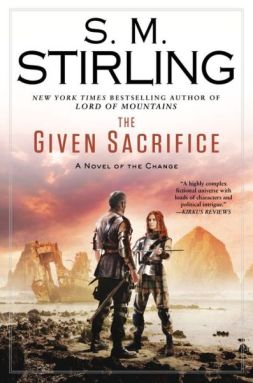
Book Review: The Given Sacrifice by SM Stirling (Fiction)

The Given Sacrifice, the 10th book in The Change series by best-selling author SM Stirling, continues to explore what would happen if the lights went out for good and things like guns and bombs also stopped working. Filled with likable and realistic Pagan, Heathen, and polytheistic (and many non-Pagan) characters it portrays our rituals, ethics, and Gods as positive, vibrant, and diverse. There are also positive portrayals of several GLBT and female characters in leadership and combat roles. A wonderful mix of alternative history, post-apocalyptic fiction, and classical fantasy genres.

Book review: Lord of Mountains
Book review for Tears of the Sun (Also gives more background on the series as a whole)
Authors Books Change Opinions about Paganism

The series primarily focuses on how humans in what was the USA survive the loss of 600 years of technological progress after an event called the Change happens, which causes electricity, guns, explosives, and other methods of power production to stop working.  Approximately 90% of the population dies off and small bands of survivors form around charismatic leaders.  Some of the leaders in the Pacific Northwest and New England areas are Wiccans and Heathens. Others are Buddhist monks at a retreat, SCA members and innner city gang members who ally, a few troops of Boy Scouts who survive a plane crash, etc.  What was the modern United States is now a splintering of isolated communities that look to the past or their religion (or the Scout handbook) for inspiration and knowledge of how to survive in a Changed world. The Given Sacrifice takes place 26 years after the Change.


The_Given_Sacrifice_coverSeries: Change Series
Publisher: Roc
Available: September 3, 2013 in multiple formats
ISBN-10: 0451417313
ISBN-13: 978-0451417312
Sample Chapters: The first 10 chapters of The Given Sacrifice are here
First Book in the series:
Dies The Fire, Sample chapters here

Knowing the title of the book it’s not a spoiler to announce that the main character of the past four books (or the past 7 – depending on how you look at it), High King of Montival Rudi Mackenzie, dies. He’s been fated to die for the land since he was born and readers pick up the book knowing this will happen. Knowing how the book ends, can the author hold attention and not stoop to maudlin tear whoring? Absolutely.

The first 2/3rds of the book brings the Cutter War, a war for humanity’s very survival, to a successful conclusion with Wiccan Rudi Mackenzie and Catholic Mathilda Arminger as the main characters. Just under half of what was the United States is once again united as the Kingdom of Montival, a loose federation of independent and highly varied governments, people, and cultures. Other characters, sure to be a focus in future books, are fleshed out or introduced. The last 1/3 of the book is a series of vignettes that show consolidation of the kingdom through the eyes of Rudi and Mathilda’s Wiccan daughter, the Crown Princess Orlaith and her female squire, Heuradys, a Hellenic Pagan.

Montival, under High King Rudi and High Queen Mathilda, have won several decisive battles against the villains of the tale, the Church Universal and Triumphant (AKA, the Cutters). The Cutter’s reluctant allies, the United States of Boise, are still a formidable force but defections have weakened their numbers. As Rudi considers the populations of both Boise and the Cutter territories his future subjects, he’s trying to win a war against ruthless and skilled opponents with as little bloodshed and hard feelings as possible. The final battles are a mix of straight out war, a fierce spiritual battle in another plane of existence, enemies turned allies, and guile. It’s refreshing to read a tale of war that doesn’t glory in killing or is filled with weapon porn, yet is still filled with intense action and plausible military strategy.

“I’m tired of winning battles!” [Rudi] said, controlling the flush of anger. “I’m tired of killing brave men whose only fault was to be born in the wrong place and to get levied from the plow! I want to win this bloody war, and get back to my proper work and my family and let everyone else do the same!”

Exploring the extremely varied communities of the post Change world, and seeing how they developed from something familiar and mundane to something extreme is one of the most fascinating aspects of the series.  Each book gives us both a tease of one of these communities and a longer visit to one previously teased. The Morrowlanders (aka The Scouts) almost stole the show when they appeared in just a few pages of The Scourge of God and I was thrilled we got a longer look at them in this book. The Morrowlanders, who consist of a few troops of Boy, Cub, and Girl Scouts, crash landed in a remote wooded area when the Change hit.  Cut off from outsiders in a cold, wooded environment on a lake, the few surviving adults quickly die or are killed trying to care for the children in their charge. One of the older children, a badly burned and injured Eagle Scout, uses the Scouting handbook to help the group of mostly young children survive and they cling to the Scout Law with a religious fervor. Almost 30 years later they are a warrior tribe who place a high value knowledge, honor, and skill. Learning more about how this group survived and evolved is both charming and heartbreaking. This is the anti-Lord of the Flies and is an example of how Stirling takes a different tack on post-apocalyptic literature. The fate of a group of boys left to survive on their own could have come across as grisly and depressing, but the author focuses on how humans band together and not only survive, but thrive in this new world they find themselves in.

The group that is teased in The Given Sacrifice won’t be a minor group. Their land will be the main stage for the next set of books in the series and we are barely introduced to them in the final vignette of the book. Rudi is taking a now adult Princess Orlaith on a tour of newly settled lands in what was California wine country. You’ll see many familiar faces in the settlers as Bearkillers, Dundain, and Mackenzies’ are all expanding into the area. A group of strangers has arrived by boat and are under attack by pirates. If the Montivalians don’t intercede the strangers will soon be wiped out. Rudi makes the decision to come to their aid and, since the battle is won, we find out who these visitors are. Folks, the Land of the Rising Sun once again has an Empress and, due to an act that will enrage all of Montival, we will be heading to the Pacific Basin along with Orlaith and a new generation of heroes.  As was foreshadowed earlier in The Given Sacrifice when Orlaith was still a baby, we’ll learn just how Changed the world is when this third generation comes to power.

“Just now,” Sandra said, tickling the tip of the baby [Orlaith’s] nose with one finger as she smiled and kicked, “it struck me that I should wonder what the world will be like when Órlaith’s generation is in charge… people who never knew the people who knew the world before the Change. When she’s my age it will be… Good Lord, it’ll be Change Year 84! Nearly a century! Will they really believe anything about our world by then, except as myths? And of course her children…” From chapter six, The Given Sacrifice 

We’ll find that out in The Golden Princess, the next book in the series, scheduled for publication in September of 2014. For now, enjoy The Given Sacrifice. I did!

Editor’s note:  I was provided an advance reader’s copy of the book for the purpose of writing a review. I was also asked by the author for suggestions on a section of The Golden Princess that has a Hellenic ritual.

Teo Bishop appearance at Sacred Harvest Festival – Interview

Teo Bishop

Teo Bishop

Teo Bishop is pretty unique in the Pagan world. If you know of him, you probably know more about his spiritual ponderings and quest, than about who he is!  He is a  blogger,  bard, and  contemplative Pagan, the  author of Bishop In The Grove, a  regular contributor to  HuffPost Religion, and Columnist at The Wild Hunt. He is also one excellent musician and song writer.

Read a bit of Teo’s  history here

I talked by phone to Teo Bishop in Los Angeles about his upcoming appearance beginning next Monday at Sacred Harvest Festival, Aug 5-11th.

Have you ever been to Minnesota before?
Teo; I have been to the Twin Cities once before on a promotional tour. I think the theater was in St. Paul. This is the first time I’ve been during the “warm” part of the year!

And you are out in Los  Angeles now?
Teo; Yes. Most of the time when not at home in Colorado I am doing some kind of work in the music industry. Music is my primary work. Mainly I write songs for artists. You could think of it as applying my bardic skills in the pop music world.

In addition to songwriting, do you plan on resuming a musical performance career?
Teo; I’m not really focused on performance right now. I spent the majority of time between 2008 and 2011 working to cultivate a career as a performer and recording artist. My focus right now is on songwriting, and more behind the scenes work.

From Letterman appearance as Matt Morris

It is an exciting time, though, because the last few weeks have been exceptionally creative. In the past eight days I have written eight new songs. It’s a vibrant time, and I’m excited to take that creativity and bring it to Sacred Harvest Festival!

You recently announce leaving the Ár nDraíocht Féin: A Druid Fellowship (ADF).  Was that difficult? Are you still a Druid?

Teo; I still very much feel like I am on a Druidic path. I don’t think you can ever truly disassociate yourself from traditions you have been a part of, and ADF has been very influential on me. So leaving ADF was a difficult decision to make, yes. But I decided to leave because it just felt, in all of my parts, like the right thing for me to do at this point in my own spiritual evolution.

My leaving made a splash only because I am fairly public with aspects of my spirituality and my process. I’ve also been in a role of leadership within ADF, and I feel very happy about how things have been progressing in my absence, particularly with the Solitary Druid Fellowship.

I think it’s important to understand that this is not some big dramatic event, but that my own process has led me to leave. I’m not on a crusade against ADF. There are many wonderful people in ADF who have genuinely been kind to me — both before and after this decision.

Are you headed down a different path now?
Teo:   I’m not sure exactly what path I’m on at the moment. I feel like my “ordinary”, non-religious life has a great number of spiritual teachings to offer me. I am still tremendously influenced by the teachings of ADF Druidry, in the same way that before that, before being a Pagan, I was influenced by Episcopalian Christianity. It is all part of a continuum for me. The creative work I am doing — the work that happens apart from any one spiritual path or tradition — feels like the best thing to focus on at this point.

Teo Bishop

Teo Bishop

This is your first appearance as a guest at a Pagan event, what are you looking forward to?
Teo:  I’m looking forward to meeting so many people that I’ve only engaged with online. I think it’s important for internet-entered Pagans to get out there, in the dirt, and get to know each other. I’m looking forward to that. I’m also looking forward to offering up my experiences and insights into the creative process to the community. I’d like to find ways to conceive of our creativity and our spirituality as synonymous aspects of our lives.

You are offering both a kids workshop and a ritual, is this new for you?
Teo: Actually, I have done some work with kids outside of a festival context. My mom is a teacher and I have worked with kids to help them develop their creativity and use their own creative voice. This is comfortable territory for me, and I think the young people at the festival will have a lot to offer.

I’m also excited about leading ritual. I’ll be incorporating some aspects of ADF Druidry, as well as seeking to use movement and voice as a catalyst within the ritual to enliven us and revitalize our own sense of creativity. We’ll make a good noise!!

I think the festival will be a really great time. Everyone involved has been extremely kind, generous and hospitable with me, and I’m looking forward to giving the “Tribe” a big old hug when I get out there!

Teo Bishop  is a featured National Guest at Sacred Harvest Festival   located at Harmony Park in  S. Minnesota near Albert Lea , Aug. 5-11th.  Teo is offering several workshops, a ritual, and a performance –  Workshop Schedule

Discount advance registration for Sacred Harvest Festival  ends Thursday Aug 1st,  Gate Registration is also available at event.

Nels Linde is a Council Member of Harmony Tribe which sponsors Sacred Harvest Festival.