PSG – New Home, Same Spirit

The Pagan Spirit Gathering, one of the largest and oldest Pagan camping festivals, has changed location this year. The former site, Camp Zoe near Salem, Missouri, has come under federal investigation. This prompted Circle Sanctuary, hosts of Pagan Spirit Gathering, to move the festival to Stonehouse Park near Earlville, Illinois.  It is a venue change that many past attendees are applauding.

Pagan Spirit Gathering
Summer Solstice, June 19-26
Stonehouse Park near Earlville, Illinois
Registration closes June 4th

“I love going to PSG, but it was so hot and humid at Camp Zoe that I wasn’t going to attend this year.  All I did was lay in the creek and I missed most of the workshops because it was so hot.  But now that it has moved to the much cooler and less humid Illinois, I’m going!” said past attendee Eisling, “Just think, it should be nice enough we can even have camp fires at night.”

PNC-Minnesota talked with Ghetto Shaman Billy Crow Staver about the move to Stonehouse Park and what PSG will be like this year.  The Ghetto Shamans are a camping group that attends PSG each year and helps Circle Sanctuary with marketing the event.

“The PSG experience is something really special.  It’s a place where people can come together and let their guard down.  Magically things happen there.  It’s where I met my wife, I met her at PSG.  I’ve met some of my best friends through PSG,” Mr. Staver said of his years of attendance.  ” The people who attend PSG seek new connections to the Divine and form a new tribe.  It’s an experience that is hard to explain and shouldn’t be missed.”

Organizers say Stonehouse Park offers many more amenities than they have had at other PSG camps.  “There are more electrical hook ups throughout the camp.   There’s a larger shower house and a community store.  People will be able to keep their camp site cleaner since they have community sinks available for dishes and washing your clothes,” says Mr. Staver.  He notes the best change will be in how the camp feels to attendees, ” We’ll be able to camp closer together and be able to see one another and this creates more of a family community type feeling and that’s one of the biggest benefits to camping at Stonehouse park this year, we’ll get that feeling of a close family again.  We kind of lost that at Camp Zoe.”

Continue reading

Pagans in Prison – Editorial

Click for large image!

We have had an explosion of incarceration in the United States in the last 30 years.  Minority races, the poor, and least educated continue to be way over represented as inmates statistically. Addiction, and our society’s inability to cope with the plague it represents, contributes to arrests and recidivism, and drug offenses fuel incarceration rates. Young males dominate the populations of our prisons, while female rates explode proportionately but in smaller overall numbers. One in 28 US kids has a parent in prison, and that tells much of the story of where the males are that might be a role model.

The religious civil rights of Pagans, or any inmate, are now well established in law. Whether the implementation of that law takes place seems to depend on individual states, institutions, and the staff and chaplains who work within them. Officials and inmates can work together to find reasonable accommodation to individual spiritual practice, and equity of accommodation among the many spiritual paths in prison, or we can all bear the cost of resolving these issues through the courts.

Inmates pay for their crimes through the loss of their freedom. To expect them to lose the rights our Constitution considers basic human rights is more for our satisfaction and as ‘punishment’ for those who may have caused us pain or harm.

Continue reading

Pagans in Prison – Inmates Comment

The inmates at various Department of Correction Facilities have been tracking this discussion of Pagans in Prison, and are aware of the civil rights issue in Stillwater Prison.  Nearly all Pagans in prison find that path in prison. They have no history with a ‘Pagan community’. They have the idea that we as Pagans have a spiritual community like many Christian groups do. Inmates, therefore, tend to have a real idealized vision of our ‘Pagan community’. We are presumed to have facilities, programs, ministers, outreach programs, and the dedication to help our ‘brethren’ in need, and they know they certainly need help. Maybe they suffer from the same attitude we hold, we want a lot from our community and don’t have the time or resources to put a lot into it.


Many of the facilities have functions, and  Faribault is considered an ‘exit’ facility. It houses over 2200 mainly low risk inmates, double bunked, with mainly shorter terms. They are preparing to leave incarceration in a few months to a few years, and will be approaching our community as they seek their Pagan paths.


What do you want from the Pagan community as Pagans in Prison?

 We want to be able to learn more, and to be able to meet people in a positive fashion. We want to start building  some positive relationships now, that will be available to us once we get on the outside. Ninety percent of us are here because of the people we hung around with. When we get out, if we hang with the same people, we will be back in here. We need Pagan people to hang with! Continue reading

Pagans in Prison – Women Ministers in Prisons

Emrys Anu is a Wiccan Minister volunteering for the last six years at Rush City Correctional Facility.  She has volunteered in the past at Red Wing (18 months) and Stillwater Correctional Facility (2 yrs.).

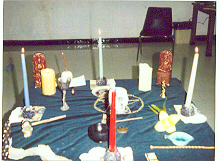
A Prison Beltane Altar

What is it like working with your “guys”?

They are funny, engaged, and interested. They are incredibly grateful for the time and interactions that any volunteers bring. Just to show up, look them in the eye and shake their hand and treat them like human beings. They don’t get that often enough except with the religious volunteers. I think that attitude sets the foundation for the engagement. We develop a give and take trust that makes education in this setting possible. The topics that we touch on are the difficult topics of life transformation. We don’t talk about their crimes, they all know that they are in their for a crime, we even joke about it. Once I mentioned, “Ya, well I get to go home after this”, and they replied, “Ya, they keep us here because we are criminals”. They know that they have made bad choices. In those moments when they are calm and grounded and connected, they want to be able to make better choices and know they don’t have the skills to do that. Continue reading

Local Celebration of International Pagan Coming Out Day

From a formal High Tea to a rally on the White House lawn, Pagans across the globe are celebrating Pagan Coming Out Day on May 2nd with local events and rituals.  The Twin Cities celebration includes cocktails, desserts, and the screening of American Mystic – a movie that the Wild Hunt called “the best documentary involving modern Pagans that this generation has seen.”

The event takes place May 2nd at the Sacred Paths Center and is open to all Pagans and Pagan allies, no matter if you have been ‘out’ for ages or are not yet able to be open about your Pagan spirituality.  It directly follows the usual Monday night Pagan Potluck and the event is offered as a free gift to the community.  An opening Hellenic-style libation to Hestia, a Goddess that strengthens the bonds of family and community,  kicks off the evening, with champagne cocktails, non-alcoholic drinks and desserts to follow.  Once everyone has their treats, the movie American Mystic will be screened for the first time in the Twin Cities area.  The documentary opened at Pantheacon to rave reviews. More about the movie below.

Pagan Coming Out Day Twin Cities
May 2nd – Sacred Paths Center
7pm to 9pm

Pagan Coming Out Day is an international movement created to be complimentary to Pagan Pride events. It’s a day when individuals, deciding on their own terms, stop actively hiding their religious identity to someone in their life. It’s also a day when our religious community comes together to support those coming out to a person or group and celebrates the more public emergence of their Pagan identity.   The not-for-profit organization behind Pagan Coming Out Day says they are “working to achieve greater acceptance and equity for Pagans at home, at work, and in every community.” To learn more about Pagan Coming Out Day you can go to their website or friend them on facebook.

Chuck, a Lakota sundancer in the badlands of South Dakota

Morpheus, a Pagan priestess in southern California

Kublai, a Spiritualist in upstate New York

AMERICAN MYSTIC is a documentary about three twenty-somethings, each a member of a fringe religious community, who have separated themselves from mainstream America in order to live immersed in their faiths. Kublai, a Spiritualist in the former revivalist district of upstate New York; Chuck, a Lakota sundancer in the badlands of South Dakota; and Morpheus, a Pagan priestess living off the grid in old mining country in southern California. Rather than an analytical, journalistic approach, AMERICAN MYSTIC takes a personal, visually lush approach, immersing the viewer in the subjects’ experience of their controversial faiths through their own words and worship.

Editor’s note:  Cara Schulz, editor at PNC-Minnesota, Chairs the Executive Committee of International Pagan Coming Out Day.  Jason Pitzl-Waters, Project Coordinator of PNC and author of the The Wild Hunt, also serves on the Executive Committee.